Viennale 2015 – Day 6: The Lobster

The LobsterThe Lobster
Ireland | UK | Greece | France | Netherlands | USA 2015
Written by Yorgos Lanthimos & Efthymis Filippou
Directed by Yorgos Lanthimos
Watched on 27.10.2015

“The Lobster” starts off so strong that for about half of its running time, I thought that it would turn out to be my first big highlight of this years Viennale. Unfortunately, I didn’t much care for the direction that the movie took in its second half. It’s still a good movie with a great, funny and original premise, but I wish that they would have stuck with the plot in the “hotel”.

—————— SLIGHT SPOILERS AHEAD ——————

What I loved first and foremost about “The Lobster”, is its initial premise: The movie takes place in some sort of near future, or in a parallel world, where singles are sent to a hotel, where they then have 45 days to find a new match – otherwise they get turned into an animal of their choosing. What a fascinating, original and bizarre idea! The first half, which takes place in one of these hotels, is full of funny moments and great scenes. However, it’s not just all laughs… there are also some quite interesting observations about love, couples, and the emphasis that our society puts on romantic relationships. Did you ever notice that in movies and tv-shows, singles are the first to be sent into danger, as if their life somehow would be worth less? “The Lobster” makes some similar observations, which I found very interesting. I also loved some of the absurdities that take place in the hotel just so that you find a new partner and thus avoid being turned into an animal. The whole setup is completely absurd, and at first, the film is full of – often times rather dark – humor. As far as the first half of the movie is concerned, which offered a great (although obviously completely exaggerated) parable on our society, and the pressure of finding a romantic partner, I loved pretty much every second of it – even though being single myself, I occasionally found it to be a little depressing (in a good way, though).

Unfortunately, when David escapes from the hotel and meets the resistance, “The Lobster” starts to stumble. First of all, instead of presenting a positive alternative, David jumps out of the frying pan into the fire. He simply switches one totalitarian, repressive system for a different – and diametrically opposite – one, because where in the hotel (and thus as part of society, as it is depicted here), he had to find a romantic partner in order to stay human, here all romantic relationships are strictly forbidden. And as much as I could appreciate the idea concerning the hotel, and the pressure of society to find another partner, this later part didn’t work for me at all. It’s just a dumb idea, and one has to ask yourself why those people put up with that (while the other system is very institutionalized, thus it would be harder to oppose). Additionally, the way that “Loner Leader” (as she is credited on IMDB, even though I’m pretty sure we heard her name in the movie, but I don’t recall, sorry) ultimately learns of Davids affair felt incredibly forced and stupid (and was also very predictable). Finally, I didn’t care much about the open end. Sometimes, a movie can profit from something like that, but here, it felt to me as Yorgos Lanthimos didn’t want to alienate anyone – thus, just not providing an answer felt rather cowardly to me. Also, the longer the movie went along, the more noticeable it was to me how repetitive the music was. Another reason why a shorter running time would have been preferrable.

Overall, “The Lobster” seems like a weird combination of two movies, that never quite make a match. I loved everything about the hotel, but found most of the stuff in the woods unconvincing. Occasionally, the second half still managed to grip and excite me – like when they go on their mission – but even then it doesn’t even come close to the great setup and beginning. Which, given how much I loved pretty much everything about the first hour or so, is a crying shame.
6/10

IMDB

Posted in cinema 2015, movie reviews, new releases, Viennale | Tagged , , , , , , , , , , , | Leave a comment

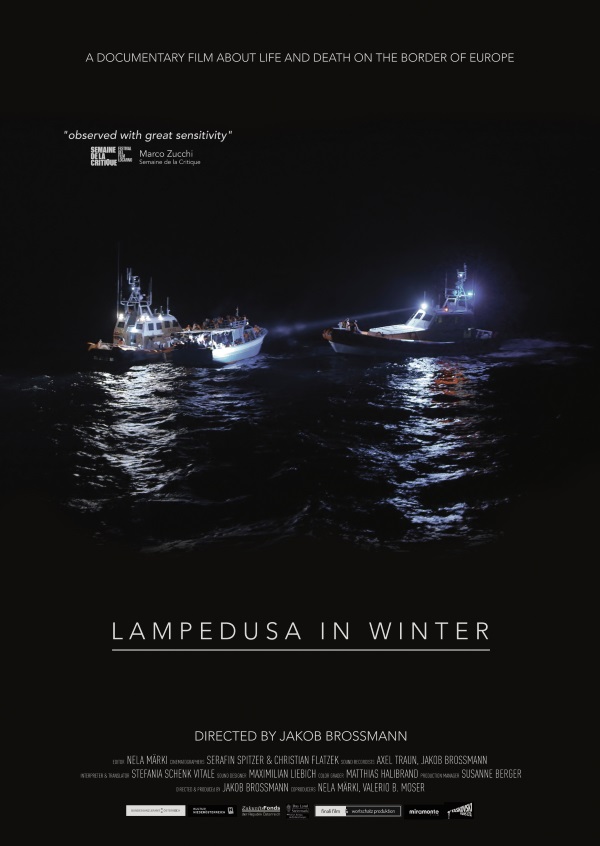
Viennale 2015 – Day 6: Lampedusa in Winter

Lampedusa im WinterLampedusa in Winter
Austria | Italy | Switzerland 2015
Written by Jakob Brossmann
Directed by Jakob Brossmann
Watched on 27.10.2015

I’m afraid the Viennale programme didn’t do this documentary any favors in indicating that – like “Last Shelter” – “Lampedusa in Winter” would first and foremost deal with the refugee crisis. Instead, Jakob Brossmann wanted to portay the island itself, as well as its inhabitants, in order to show the people behind the news. And while I can appreciate that objective, ultimately I would have preferred a different approach.

My main issue with “Lampedusa in Winter” is that I found everything that dealt – even remotely – with the refugee crisis much more interesting than the parts about the struggles of Lampedusa’s inhabitants. Don’t get me wrong, of course they are people who, despite the fact of where they live, have their own problems, and face their own challenges. And in a different context, I would have very much felt for and sympathized with them. However, contrasted with the plight and struggle of the refugees, their strike concerning the ferry seemed rather mundane in comparison. I don’t want to shrug off their problems, but compared to countless refugees that drown in the Mediterranean Sea, it was a little difficult for me to really feel for them. I also felt that the middle part of the documentary dragged a bit. I was further irritated by the fact that after the immediate crisis surrounding the occupation of a church is solved, we never again return to the five refugees that have to stay behind. And as much as I appreciated the fact that Jakob Brossmann refrained from a direct commentary, a little bit more background information here and there would have been nice. Lastly, some scenes seemed staged to me, and while I believe Brossmann when he says that everything happened as we see it, I still got the impression that some of the things that were said and done were mostly for the camera. Not on his insistence, but rather because the people knew that there was a camera pointed at them. Then again, that’s just my impression, and I don’t rule out that everyone acted natural and just as they would have done if there wouldn’t have been a camera around.

Having said that, it should come as no surprise that everything that directly related to the refugee crisis worked best for me. That’s were “Lampedusa in Winter” really managed to grip me, and where it featured its best, strongest and most haunting scenes. Like with the S.O.S. at the beginning, or the devastating scene where they sift through a boat that capsized, with all hands lost. Or the museum of things found in such boats. Or the collection of letters and diary’s salvaged from the sea, that provide an insight into the thoughts of some of those who perished at sea, after going on this journey in the hope of a better future. Or the interview with the lady who received the S.O.S. signal that we hear in the beginning. Or the final rescue mission which in a way circled back to the beginning of the movie. All those scenes were very powerful and haunting. For me personally, it was also extremely depressing to see the mayor or Lampedusa take such a personal stance during the crisis with the occupied church, since I immediately asked myself where our politicians were when some refugees occupied the Votiv church (see my review of the aforementioned “Last Shelter”). Why couldn’t they react in a similar way? Instead, they did nothing, and just waited for the issue to resolve itself. Thus, seeing a different – better – way to deal with a situation like that was quite frustrating for me.

All in all, everything that directly dealt with the plight of the refugees, as well as the distressing subject of countless people losing their lives while trying to reach Europe via the Mediterranean Sea, really managed to grip and affect me. But whenever “Lampedusa in Winter” turned its attention to the struggles of the inhabitants of the island, it lost its appeal for me – which is why overall, I felt it to be a little bit of a mixed bag. Despite that, I’d definitely recommend it to everyone who is interested in this current hot topic.
5/10


IMDB

Posted in cinema 2015, movie reviews, new releases, Viennale | Tagged , , , , , , | Leave a comment

Viennale 2015 – Day 6: Fatima

FatimaFatima
F 2015
Written by Philippe Faucon, based on books by Fatima Elayoubi
Directed by Philippe Faucon
Watched on 27.10.2015

“Fatima” deals with the generational split within (some) immigration families. Fatima came to France so that her children could have a better life – and better prospects for the future – than herself. She works her ass off to provide them with the best education possible, and while her older daughter Nesrine – who starts to study medicine – appreciates that, her younger sibling Souad, who just reached puberty, seems like an ungrateful brat. When one day, Fatima stumbles down the stairs and hurts her arm, healing is not just a physical, but also a psychological matter.

“Fatima” can roughly be separated into two main storylines: Fatima’s and Nesrine’s. Among these, I have to say that I found Nesrine’s story more gripping – quite possibly because while I don’t have kids yet, I can very much appreciate the pressure that goes along with studying (it might be 10 years since I finished my studies at a University of Applied Sciences, but I still remember that time vividly). Thus, it was easier for me to relate to her, than to her mother. What especially got me was the huge amount of pressure that she was under. Studying itself can be hard and stressful enough, but when you know that your mum is working herself sick for you, and sells her jewelry etc., just so that you can follow your dream, the pressure increases tremendously, and I definitely didn’t envy her. Nevertheless, Fatima’s struggle was quite gripping, too, especially because of her troubles with Souad, which further added to her (already substantial) burden. I also liked all the performances, the glimpse into the live of immigration families that it offered (I especially found it interesting that Fatima speaks in her mother tongue, and her children speak french, and they still seem to understand each other just fine), as well as a couple of very strong, individual moments.

There were a couple of things, though, that didn’t speak to me quite as much. For example, as great as Fatima’s poem was in itself, I think I just wasn’t the target audience for it, since she’s kinda addressing it to those who look down on her, which I’d never do. I don’t care if you’re rich or poor, what job you have etc. The amount of money in your savings account doesn’t concern me. All I care about is if you’re a kind person. Everything else is just smoke and mirrors. Thus, this poem wasn’t as eye-opening for me as it arguably was intended to be. More importantly, “Fatima” feels more like a loose combination of individual vignettes, and – apart from Nesrine’s studies – missed a clear narrative and/or structure. I also could think of a couple of questions that would have been interesting to address. For example, I wonder what would have happened if one of the girls would have brought home the “wrong” boyfriend, or even a girlfriend? How would Fatima and/or her ex-husband have dealt with that? And overall, even though I get that it was a character trait (and possibly a sign of her more uptight upbringing compared to her daughters), Fatima was just a bit too quiet, obedient and submissive for me. Despite those minor complaints, though, it’s well worth watching, offering an interesting glimpse into the often difficult and demanding life of immigrants, who do their best to offer their children a better future than they ever could have even dreamed of for themselves.
6/10


IMDB

Posted in cinema 2015, movie reviews, new releases, Viennale | Tagged , , , , , , , | Leave a comment

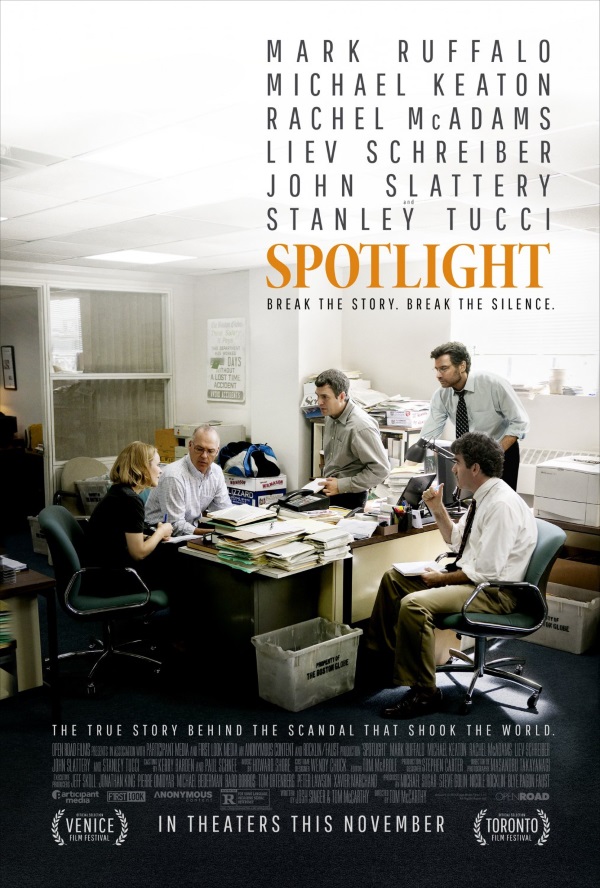
Viennale 2015 – Day 6: Spotlight

SpotlightSpotlight
USA 2015
Written by Tom McCarthy
Directed by Tom McCarthy
Watched on 27.10.2015

“Spotlight” is an ensemble piece that chronicles the exposure of multiple cases of child abuse – and their subsequent cover-up – within the Catholic Church in Boston by a team of investigative journalists from the Boston Globe. Based on true events, it’s as much a plea for print journalism as it is an important contemporary document that gives background information, context and life to 2002’s headline.

Unfortunately, the fact that there are many cases of child abuse within the Catholic Church – worldwide – isn’t really news; we also had our share of cases here in Austria. Which is probably why I found the systematic cover-up even more shocking than those cases themselves. To see how far-reaching it is, how pretty much everyone knew what was going on, but how, due to its power, the Catholic Church in Boston still managed to keep it under wraps for so long. There were also some revelations – like a rehabilitation program for such priests, or the fact how they simply get transferred to another parish, where they again get the chance to prey on children – that I found quite shocking. I also loved that “Spotlight” doesn’t simply grant absolution to the journalists – even the ones who ultimately lifted the lid on it. They all had heard rumors and reports of multiple cases, but simply decided not to follow up. How many cases could have been avoided, if they would have acted sooner, instead of turning a blind eye? I loved that the Spotlight-team isn’t simply exonerated from that, and that they’re not the clear-cut heroes of this film. Nevertheless, “Spotlight” leaves no doubt that when they finally looked into it, the team of the Boston Globe did a splendid job, and they definitely deserve credit for that – and for going ahead with it, despite the pressure from the Church, friends, family etc.

They are brought to life by an impressive and immensely talented ensemble that includes Mark Ruffalo (who once again threatens to steal the show), Rachel McAdams, Liev Schreiber, John Slattery, Brian d’Arcy James and Michael Keaton. They are all great in this, and each and every one of them get their moment to shine. There were a couple of especially strong moments, like with Mike and Sacha on the porch, or when her grandmother finally reads their report. What you should keep in mind, though, before rushing into the cinema, is that while it’s advertised as a “tense investigative dramatic-thriller”, John Grisham this ain’t. It’s rather a quiet, slow-built drama than a hard-hitting thriller. There’s very little tension, and of course, since it’s based on true events, we also already know how it will ultimately end. It’s not flashy and not over-dramatized, but offers a rather factual, sober look behind the scenes of this particular Boston Globe article. Overall, “Spotlight” is an important and well-made movie that puts the spotlight on the shocking years-long cover-up of cases of sexual abuse within the Catholic Church in Boston, and the team of investigative journalists that finally brought it to light – which makes it a must-see for everyone who’s even mildly interested in journalism and/or said scandal.
8/10


IMDB

Posted in cinema 2015, movie reviews, new releases, Viennale | Tagged , , , , , , , , , , , , , | Leave a comment

Viennale 2015 – Day 5: Last Shelter

Last Shelter
AUT 2015
Written by Gerald Igor Hauzenberger
Directed by Gerald Igor Hauzenberger
Watched on 26.10.2015

“Last Shelter” is a good, objective and well-made documentary that nevertheless, in my opinion, missed the last punch. I didn’t find it particularly thought-provoking and/or evocative. It’s further hurt by the fact that in a way, our present seems to have caught up with the events portrayed here. Back in 2012, a couple of refugees who occupy the Votiv church were a big deal, but with the recent flow of refugees coming to Europe, they seem like a minor note – something that Gerald Igor Hauzenberger tried to take into account with an epilogue that, while connecting the past crisis with current events, might have been better suited as and would have very well been worth a documentary of its own.

What “Last Shelter” shows, however, and which gave me the chills, is the total help- and cluelessness of the politicians. If they were already unable to cope with 30-40 refugees who occupied the Votiv church in order to finally force them to do something, how are they ever going to deal with recent events? Now, of course, the lethargy of Austrian politics is nothing new. And, to be fair, there were some of them – albeit very few – that tried to deal with the situation, instead of simply ignoring it. Nevertheless, it was easy to sympathize with the refugees, their struggle and their accusation that the politicians just didn’t care about their situation. Thus, it was also understandable – and heartbreaking – to see them going on a hunger strike in order to finally compel a response. “Last Shelter” also shows that the ambulance, the clergy and non-profit organisations like Caritas can only do so much, but ultimately are equally helpless if the politicians refuse to (re)act. Our connection with the refugees is further heightened by the fact that Hauzenberger only shows the proceedings from their perspective. Third parties are only a factor when they interact with the refugees, otherwise, we only see, hear and experience what they see, hear and experience. I wouldn’t go so far as to say that it puts the audience into their shoes, since that would just be cynical. I’m neither starving nor did I have to flee from my home country because of war or persecution. But it nevertheless helps the audience to identify with their plight and their struggle.

Where “Last Shelter” also shined was in giving us a follow-up to those headlines from the past – since after the occupation ended, those refugees pretty much dropped from the face of the earth, at least as far as the media is concerned. There also were a couple of moments that really stood out, like when one of the refugees rallied against the Austrian government, and you could hear the passing remark “Fuck foreigners” from a passerby. There also was a really cute wedding, with their love story presenting a glimmer of hope in the otherwise bleakness of the picture. My favorite moment of the documentary, however, was the extremely weird scene where a group of bridesmaids on a bachelorette party meet a protesting refugee. That was just bizarre. My biggest complaint, however, is my belief that ultimately, “Last Shelter” is preaching to the choir. It will only reach – and touch – those who are already sympathetic towards refugees, but I don’t really see it changing the minds of those who are skeptical if not outright hostile towards them. Putting more emphasis on their stories, and the reason why they fled their countries, might have helped with that. As it is, “Last Shelter” is an important contemporary document, that – thanks to recent events – unfortunately nevertheless already feels dated, even before it reached the cinema.
7/10

Posted in austrian cinema, cinema 2015, movie reviews, new releases, Viennale | Tagged , , , , , , | 1 Comment

Viennale 2015 – Day 5: Queen of Earth

Queen of EarthQueen of Earth
USA 2015
Written by Alex Ross Perry
Directed by Alex Ross Perry
Watched on 26.10.2015

“Queen of Earth” was one of the movies that I looked forward to the most at this years Viennale. So much so, in fact, that I was a little pissed off about the fact that I would miss the first screening because of a birthday party (Seriously, folks: Don’t schedule anything during the Viennale, at least if you want me to show up 😉 ). Fortunately for me – and him 😛 – they showed it again in the afternoon on the following day (which was a national holiday), so I didn’t have to wait too long to finally see it. Unfortunately for me – and the movie – I was rather disappointed by it.

“Queen of Earth” first and foremost is yet another showcase for Elizabeth Moss’ considerable acting talents. Right from the start – in a long scene with Catherine’s devastated reaction to a breakup – she’s absolutely stunning, and even though “Queen of Earth” ultimately might have disappointed me, that’s not in the slightest her fault. She is, hands down, the best thing about the movie, delivering a performance that I seriously hope to get some attention come awards season. Emotionally, she bares it all here, playing an extremely vulnerable, depressed and occasionally vile character that hit rock bottom, and doesn’t seem to find a way out of the hole that she fell into. Katherine Waterston has a far less showy role, but is also really good as her longstanding friend Virginia, who seems to be caught between her desire to help and to get rid of her. There also were a couple of standout moments, where Perry – like in the aforementioned first shot – employs long takes to really draw the audience in, like when Catherine and Virginia walk down memory lane, or when Catherine finally lashes out at the dinner (hands down one of the best scenes of the movie, and a really strong moment for the character). I also really liked its dark and depressing atmosphere. From the get-to, Alex Ross Perry – with help by Keegan DeWitt, who provides a highly unsettling score – manages to make the audience feel what Catherine feels: Extremely uneasy, constantly on the edge, and terrified of what might happen. “Queen of Earth” made me feel uncomfortable from start to finish, and evaluated simply as (emotional) experience, it was great.

Narratively, however, it’s a mess. The individual scenes, as strong as some of them may be, never really added up to anything. It’s also one of those films that go nowhere, and that refuse to provide the audience with any kind of resolution, instead culminating in a highly unsatisfactory open end that had me scratch my head in perplexity, and stomp out of the theatre in frustration. If that was the goal, then: Mission accomplished! Unfortunately, it also left me clueless to what the point of the exercise was supposed to be. Don’t get me wrong, I don’t needed, or wanted, a saccharine scene where they kiss and make up, and/or where Catherine suddenly is well again. But it would have been nice to get at least some sort of conclusion, especially since “Queen of Earth” definitely gave me the impression that it was headed for something, even though I had no idea what this something might be. As much as I loved the acting and the nice, dark, depressing mood, but thanks to the disappointing ending, and the fact that narratively, the movie didn’t really amount to anything, I ultimately didn’t have much use for it.
5/10


IMDB

Posted in cinema 2015, movie reviews, new releases, Viennale | Tagged , , | Leave a comment

Viennale 2015 – Day 5: Welcome to Leith

Welcome to LeithWelcome to Leith
USA 2015
Written by Michael Beach Nichols & Christopher K. Walker
Directed by Michael Beach Nichols & Christopher K. Walker
Watched on 26.10.2015

“Welcome to Leith” is not a documentary that wants to convey a certain message, but rather one of those that raise quite interesting questions and draw our attention on important issues, but without providing any (easy) answers and/or solutions. It also handles a difficult subject matter with a lot of restraint and care, refusing to take sides, and simply documenting this dispute between white supremacist Craig Cobb and the inhabitants of the small U.S. town of Leith. Without any narration and or commentary, it’s up to us to draw our own conclusions – something that, in this case, I very much appreciated.

“Welcome to Leith” tells the unsettling tale of Craig Cobb, who tried to take over the small, 24-inhabitants community of Leith, North Dakota. His plan was to buy up land and to build a home for white supremacists and similar thinking folk. But the inhabitants didn’t want to have anything to do with him, and did everything in their power to stop him, and to ultimately kick him out. And this is exactly where things got interesting for me. I mean, obviously, there are many stupid, intolerant, racist, hateful and potentially dangerous people out there. But if we deny them the freedoms that they in turn want to take away from certain sections of the population – are we any better than them? Or aren’t we rather fighting fire with fire? Then again, should we just let them do as they please, until they empoison our home so much that we feel the need to leave? How far is freedom of speech allowed to go? Can we really afford to wait until something really bad happens before we take action? But if we don’t, aren’t we taking away exactly those rights and freedoms that we demand for everyone else? Don’t Nazis have to live somewhere too?!?! Gosh, I really loved that “Welcome to Leith” forced me to deal with all those questions, and many more, and thus made me really uncomfortable. It reminded me a little bit of issues that we had over here, with the refugee crisis, where some people were laid off after posting vile shit on the internet (like when a fire brigade posted a picture of a little girl who enjoyed a cold shower during the heat wave in the summer, and one brain-dead shithead felt the need to suggest that they should have used a flamethrower instead). Of course such things can and should not go unchallenged. But when we lay them off – or, in Cobb’s case, force them out – are we really helping the situation? Won’t we make them even more bitter and hateful and desperate and radicalized and – possibly – violent? Gosh, I really wish I had a good answer to that.

Which is exactly why I found “Welcome to Leith” so fascinating, challenging, disturbing and important. Yes, Cobb is a terrible human being, and his plans to build a little Nazi-community had to be stopped. But when they (allegedly) slice open the tires of his car, force him out of his home, and later on, burn it to the ground… despite the disgust and fear that they must have felt, it was difficult for me to get 100% behind their actions. And that was just awesome, because it would have been so easy to stage the inhabitants of Leith as the sacrosanct heroes and Cobb and his followers as the despicable villains of this piece. Instead, it portrays them as desperate people who take desperate measures in order to defend their homes, their families and their community from Cobb’s hateful influence, but I wouldn’t really call them heroic, since there definitely are a couple of moments where they seemed to cross a line. The fact that they didn’t glorify one side in this conflict over the other, was one of the biggest strengths of this documentary for me. It also shows how hate will always trigger more hate, and suggests a seemingly endless downward spiral that I really found disturbing. There also were a couple of really tense moments, especially the camera footage of Cobb going on armed “patrol” in Leith. Nevertheless, there also were a couple of lighter moments that broke the somber mood and which I really enjoyed, like the talk show or the scene with the words that start with “n”. One of my few complaints about the movie is that during those scenes that were taken from footage shot by other guys, and with less sophisticated equipment (for example, during the town council meetings), I wouldn’t have minded subtitles, since I had difficulties understanding everything that was being said. Also, I had the feeling that the occasional scene was only there to stretch this to feature-length, but didn’t really add anything (other than running time). Despite that, “Welcome to Leith” is a vital documentary that’s as fascinating as it is disturbing, and which raises a lot of important and uncomfortable questions without providing any answers, thus forcing its viewers to grapple with this issues, and inviting them to find their own.
8/10


IMDB

Posted in cinema 2015, movie reviews, new releases, Viennale | Tagged , , , , , | Leave a comment

Viennale 2015 – Day 3: Carol

CarolCarol
USA 2015
Written by Phyllis Nagy (based on a novel by Patricia Highsmith)
Directed by Todd Haynes
Watched on 24.10.2015

I’m a sucker for romance. I think that love in general, and romantic love in particular, is one of the most beautiful things in the world. I treasure every such experience that I’ve had in my life (even though so far, they all ended badly), and am looking forward to experiencing these emotions again (hopefully). For me, there’s definitely something magical about it, and at least in my experience, this “head over heels” kind of love, especially when it’s actually requited, is rarer than we’d like to think. Which is why it always infuriates me when people, due to intolerance, oppression or simple malice, put obstacles in its way.

Enter “Carol”, which tells the story of young Therese and the older Carol, who, one fateful night, fall in love with each other – and in 1950s New York, at that, and thus at a time when homosexual relationships were pretty much unthinkable, and socially shunned. There’s something incredibly tragic about impossible love stories like that, because I’m so infuriated when society, family, religion or who-/whatever stands in the way of two people who love each other and simply want to live and be happy together. In recent years (or rather decades), things slowly started to look up, especially in western countries, but even here, and now, not everything is sunshine and roses. And I just don’t get it. Thus, “Carol” pretty much from the get-go hit a nerve with me, because I wanted nothing more than for Carol and Therese to be able to enjoy their love freely and undisturbed. The movie’s further helped by the stunning performances of both its leads. Cate Blanchett is great as always, but just because she’s always great doesn’t mean that we should simply take that (or her) for granted. Her performance here is so thoughtful and deliberate, that every slightest smirk or gesture gets a plethora of meaning. From the outset, Carol might seem like the cool and controlled one, but Blanchett leaves no doubt about the storm that’s raging inside her. Rooney Mara’s Therese is much more like an open book. She doesn’t really seem to know – or want – to hide her feelings, and wears her heart on her sleeve. She’s also incredibly vibrant and radiant; it’s easy to see why Carol would fall for her, while Therese on the other hand seems to see in Carol the person that she hopes that she’ll grow up to be one day.

Both Blanchett and Mara have absolutely great chemistry together, and I loved that the movie took its time until things got physical. Before that, it’s all in the looks, the gestures, a simple touch here and there. Both sell their growing feelings – and longing – for each other incredibly well, so that when they finally end up in bed together, it’s a release of tension as much for the audience (ok, almost as much) as it is for the characters. Due to their seemingly doomed relationship, it’s all also quite touching, and there were quite a couple of scenes that really moved me. I also loved Sarah Paulson as Abby – her performance as well as the character itself. A former lover of Carol who grew into a close friend, but who – understandably – still resists to have to play babysitter for Therese. That really was a great, interesting dynamic. Kyle Chandler also does quite well with a complicated (and difficult) character who in other hands might have come off as the bad guy of the piece. Instead, we feel that he’s just extremely hurt, and also lost, and simply doesn’t know what to do – thus, he lashes out, not realizing how he’s turning Carol’s life into living hell. And the final shot was also great and proved, like the movie itself, how much can be said with a simple look, instead of words. Pretty much the only thing I didn’t care for was that it’s yet another movie that starts with a scene from near the end. It’s a stylistic device that I’m very weary of, and I don’t think that it was warranted here, or improved the movie in any way. And overall, I have to say that I found the similarly themed “Brokeback Mountain” a little more daring, touching and devastating. Nevertheless, “Carol” is a wonderful film that I’m definitely going to revisit someday.
8/10


IMDB

Posted in cinema 2015, movie reviews, new releases, Viennale | Tagged , , , , , , , , , | 2 Comments

Viennale 2015 – Day 2: Lo strano vizio della Signora Wardh (The Strange Vice of Mrs. Wardh)

Der Killer von WienLo strano vizio della Signora Wardh
I 1971
Written by Vittorio Caronia, Ernesto Gastaldi & Eduardo M. Brochero
Directed by Sergio Martino
Watched on 23.10.2015

“Der Killer von Wien”, as it is called over here, was one of my very first Gialli (after “Profondo Rosso” last year), and overall, I had a rather good time with it. I wouldn’t call it particularly suspenseful, and it definitely has a certain trashy charm and a couple of unintentional (?) funny moments, but overall, I felt quite entertained.

“Lo strano vizio della Signora Wardh” starts off in typical Giallo-fashion. Meaning: two minutes in, you already get the first pair of boobs. And at the risk of spoiling the surprise for you: Be assured, they won’t be the last. The amount of gratuitous nudity is staggering, but as a man, it’s hard for me to complain too much about it (sometimes, you just have to let your inner, immature 13-year-old self out once again. [“Hey, look, boobs! Hehehe”, he said, in his best “Beavis & Butthead”-impression]). Since I’m living in Vienna myself, it was also really nice to get an impression of Vienna in the early 70s. Plus, I saw this in the german dubbed version, where the locals – cab drivers, policemen, receptionists etc. – all speak with a heavy Viennese accent, which was very funny to hear (usually you don’t get that with international productions), and which I also found quite charming (plus, in a weird way, it enhanced the movie’s authenticity for me). There also were many funny scenes and/or lines, like for example when Julie’s on the phone with George, talking to him, and then suddenly he stands in the doorway – and that in the pre-cellphone-age! How the hell did he manage that? The following exchange also was great: “How did you get here?” “Through the door.” (You don’t say?). Or how ’bout George’s reaction when the doctor tells him to call an ambulance? Instead of rushing off right away, he’s just standing there, dumbstruck, and asks “Is there still hope?”. Dude, just get the fuck going! And the extremely kitschy line “Time is the best healer” also had me in stitches. Granted, one might demur that most of that humor was unintentional, but I just had far too good of a time to care about that. Plus, say about the dialogues, the characters etc. what you want, but Sergio Martino’s direction was absolutely great, with the occasional dream sequences a particular standout. Even with the fucked-up 35mm-copy that I saw, I could appreciate his visual prowess. “The Strange Vice of Mrs. Wardh” also featured a galore of plot twists, and I definitely have to hold it in the movie’s favor that I didn’t see the final revelation(s) coming. My only complaints were the lack of any real tension, and the fact that I would have wished for a different (darker) outcome. “Lo strano vizio della Signora Wardh” is probably not the best Giallo out there, but if you like the genre, you won’t go wrong with it.
7/10


IMDB

Posted in cinema 2015, movie reviews, Viennale | Tagged , , , , , , , , | Leave a comment

Viennale 2015 – Day 2: Anderswo (Elsewhere)

AnderswoAnderswo
D 2014
Written by Ester Amrami & Momme Peters
Directed by Ester Amrami
Watched on 23.10.2015

I still can’t get over the fact that this movie was written and directed as graduation project of a film student. It’s so well made and shot, and feels so self-assured, sophisticated and mature, that you’d never expect it to be someone’s feature film debut. However, that’s not the only reason why “Anderswo” is awesome, because even from a more experienced filmmaker, this still would be quite some impressive work.

“Anderswo” deals with the rootlessness of immigrants, feeling not quite at home yet in their adopted country, but also not really at home anymore in the country that they left behind. They rather seem to be stuck somewhere in between, like being constantly in transit. Feeling lost in her new life and hitting a wall with her latest art project, Noa, who studies in Berlin, decides on a whim to visit her family in Israel. What was only planned as a short weekend trip gets prolonged unexpectedly when her grandma (one charming little discovery that I owe to “Anderswo”: Grannies are the same everywhere!) becomes seriously ill, which also prompts her boyfriend Jörg to also make the trip to Isreal. Hilarity, awkwardness and tragedy ensue. There are a couple of very funny scenes, but also some serious, quiet, contemplative, moving and outright tragic moments. The direction is spotless, and especially impressive when you consider the low budget-origin of this feature. The acting also is really great, with Neta Riskin and her “mother” Hana Laszlo two particular standouts. And the song that played during the credits – an interpretation of “Words” by F.R. David, but translated to german – was absolutely hilarious. I also really enjoyed the insight into jewish culture that “Anderswo” – unsurprisingly – offers up, as well as the theme of untranslatable words – and the attempt to do so anyway – which was quite fascinating, and offered interesting insights into the cultures they stemmed from. Interestingly enough, “Anderswo” itself kinda felt like one of those untranslatable terms to me, since it was a wonderful experience that nevertheless is quite hard for me to put into words. Pretty much the only thing that I didn’t like – at all – was the score. Thankfully, it was only played briefly at the beginning and at the end, thus not torturing my ears too long and/or frequently. Other than that, “Anderswo” was a greatly enjoyable and absolutely wonderful film that I’d highly recommend to anyone who’s even remotely interested in german cinema, jewish culture, and/or the hardships of leaving your home in order to live elsewhere.
8/10


IMDB

Posted in cinema 2015, movie reviews, Viennale | Tagged , , , , , , , , , , , , , , | Leave a comment