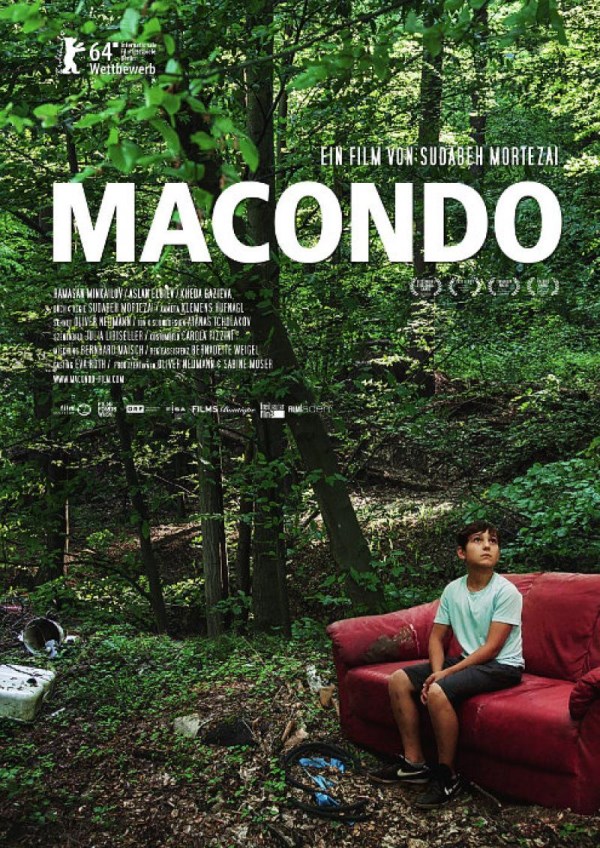
Viennale 2014 – Day 7: Macondo

MacondoMacondo
Austria 2014
Written by Sudabeh Mortezai
Directed by Sudabeh Mortezai

My first thought after watching this movie was that something can be said about the traditional “hero journey” movie structure, where the main protagonist has to overcome some outer or inner obstacle, and during the course of this struggle, grows or at least changes as a person. Which is exactly what “Macondo” is missing in my opinion. At the end, everyone’s pretty much the same, and nothing has really changed. Which made the movie seem regrettably meaningless to me.

I also had my problems with Ramasan, our main protagonist. See, here’s the thing: I’ve never been a brat. One could say that I ended up too far on the other side of the spectrum, being too nice, good and reasonable even as a kid, but the simple fact of the matter is: I just don’t get that kind of behavior and/or mindset, where you think it’s cool to, for example, key the car of a complete stranger that didn’t do anything to you. Just for “fun”. I also didn’t appreciate the way he treated his mum and glorified his dad; however, that I could at least understand to a certain degree. But because of his behavior, I had a hard time to relate and thus sympathize with him. I don’t need my protagonists to be good as gold, but “Macondo” didn’t really manage to make me understand him, and for me, that was a major problem.

What I liked about this movie is that – as so many others at this years Viennale (and as mentioned before a couple of times) – it offered a window into a different world for me. The fact that this “foreign” world is just a couple of kilometers from where I live – and that before the movie I never even knew that we had this refugee camp so close to us; it really seems like a totally different country – just made it all the more fascinating and enlightening for me. Also, the lead child actor, Ramasan Minkailov, gives an incredible, raw and natural performance, and is a joy to watch. I hope we’ll see more of him in the future. “Macondo” is far from being a bad movie; it definitely has its moments, and offers a fascinating glimpse into a totally different world that pretty much lurks right around the corner from where I live. I just wish it would have had more of a story to tell.
5/10

PS: I’m I the only one who had to think of “Pulp Fiction” during a certain scene?


IMDB

Posted in cinema 2014, movie reviews, Viennale | Tagged , , , | 4 Comments

Viennale 2014 – Day 6: Frank

FrankFrank
UK | Ireland | USA 2014
Written by Jon Ronson & Peter Straughan
Directed by Leonard Abrahamson

I had already heard some great things about this movie, and “Frank” definitely lived up to my expectations. One of my favorite things was how after about half an hour, I thought that I had the movie figured out, only for it to take a completely different – and in my case unexpected – turn. I should point out that I hadn’t even seen a trailer, thus going in almost completely blank, only knowing the most basic premise – which might have helped to make the direction that it ultimately took such a surprise for me. Thus, if you know more about it upfront or you simply see it coming sooner, “Frank” might not quite delight you as much as it did me. I’ll be damned if I’d spoil the surprise (?) for you, but let’s just say that I really liked the way “Frank” deals with ambition. Of course, the things that the movie have to say about that are not particular profound, let alone new, but still, I liked the tragic turns the movie ultimately took.

Before things take a turn for the worse, though, “Frank” is a very funny and at times quite exhilarating movie. I loved it’s depiction of the creative process. I also really liked the idea of a guy who has this fake wooden head on all the time, as well as the design of the head itself. The idea as well as the execution have something very surreal and strange. You feel kinda uncomfortable because you don’t see his facial expressions, something the movie addresses head-on (no pun intended), and I thought it was really interesting and quite revealing to see how much of our communication relies on actually seeing the other person (which is why irony seldomly works online). The music was really great too. Very strange and unusual, and it took me a while to really get into it, but ultimately, I ended up liking most of the songs. Finally, the performances were really great. Michael Fassbender manages to give Frank a personality and a humanity just with his voice, and I also really liked the ever-reliable Maggie Gyllenhaal as well as the increasingly impressive Domhnall Gleeson. So all in all, I had a really good time with “Frank”.
8/10


IMDB

Posted in cinema 2014, movie reviews, Viennale | Tagged , , , , , | 2 Comments

Merry Christmas!

Fellow Readers,

I’m sorry about the sudden radio silence, but despite all my good intentions, advent season simply proved too stressful. Between work, private life and my writing for fictionBOX, there simply was no time to continue my Viennale reviews. However, I’ll resume them during the next couple of days, and after that, I’ll have my list of the 25 best movies of 2014 (as far as I’ve seen them) for you.

Until then, I wish all of you Merry Christmas & Happy Holidays! 🙂

Posted in Uncategorized | Leave a comment

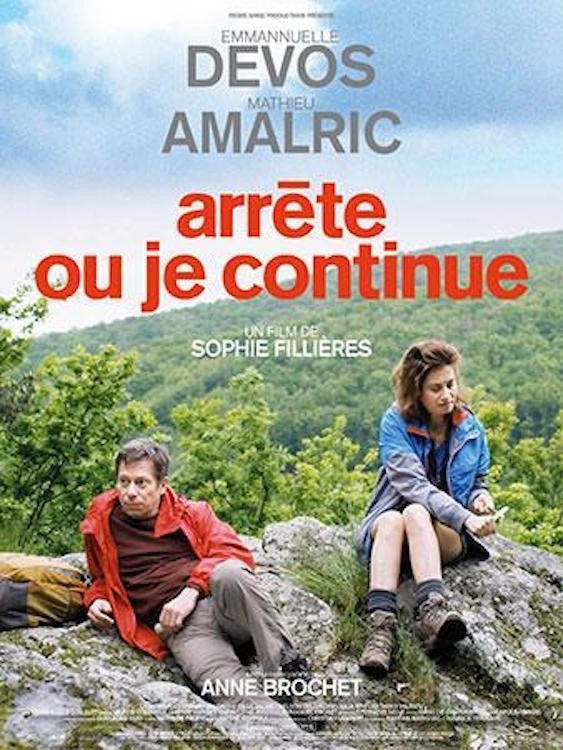
Viennale 2014 – Day 6: Arrête ou je continue (If You Don’t, I Will)

Arrete Ou Je ContinueArrête ou je continue
France 2014
Written by Sophie Fillières
Directed by Sophie Fillières

— SPOILER-WARNING! (sorf of) —
“Arrête ou je continue” doesn’t feature some sort of twist and/or shocking revelation, but my review kinda gives away where it ultimately leads. So please be aware of that before you continue reading.

While in no way a bad movie, “Arrête ou je continue” felt rather pointless to me. It pretty much could have already been over after 15 minutes, with the same result. One of my major problems with it was that I didn’t root for Pomme and Pierre as a couple. Usually, with relationship dramas like that, they make you like them as a couple so that the possible end of their relationship feels like something bad, something tragic, something to be dreaded. Here, it felt like a salvation, and ultimately, the one question that I asked myself after the movie was “What took you so long?”

Mind you, I’m not a stranger when it comes to stretching out relationships long after their date of expiry. Breaking up is never easy for me, because I’m a creature of habit, and when I’m used to having someone in my life, it’s hard fathoming losing them, as well as that sense of security and companionship that comes with it. I once had a relationship that towards the end was more like a flat-sharing community. But even shortly before we finally decided that we didn’t want to go on like that, we were in a far better and happier place than Pomme and Pierre are over the entire course of the movie. We didn’t hate each other or anything, and while we didn’t have any romantic feelings for each other any more, we still felt for each other in a way. Which is exactly what made breaking up so hard.

Each shared smile and/or laugh becomes a silver lining on the horizon, and you cherish those moments, because they provide you with at least a glimmer of hope that things could become better again. Also, you share a foundation built on love, memories and strong feelings, even though they may be remnants of the past. “Arrête ou je continue” neglects to give us any of that. There is not a single moment in the movie where I got the feeling that there’s even a slight flicker of love left between them. And Sophie Fillières unfortunately also denies us flashbacks or recollections of their happier times. Thus, I just didn’t get what kept them together – or why they were together in the first place.

That said, “Arrête ou je continue” still managed to entertain me at times. There were a couple of nice, funny scenes, and overall, for a movie that is about the possible end of a relationship, it’s surprisingly light and amusing. The acting is also very good. Emmanuelle Devos and Mathieu Amalric give two splendid performances, even though they don’t share even an ounce of chemistry – but I assume that was intentional. Both characters have their quirks and weaknesses, even if I got the feeling that the movie is a little harder on Pierre than it is on Pomme. I also liked this sort of trip to self-discovery, and the ending was great, too. Unfortunately, I just felt that it took the movie – or, more precisely, the characters – too long to get there.
5/10


IMDB

Posted in cinema 2014, movie reviews, Viennale | Tagged , , , , , , | Leave a comment

Viennale 2014 – Day 6: Calvary

CalvaryCalvary
Ireland | UK 2014
Written by John Michael McDonagh
Directed by John Michael McDonagh

Despite having been raised a catholic, I’m not a religious person. I don’t go to church, I don’t pray, and I don’t believe in some sort of benevolent higher power (though I’d call myself rather an agnostic than a flat-out atheist). Which is why “Calvary” was such an interesting viewing experience for me, since it forced me to reconsider my rather cynical view on religion, and especially the church.

Mind you, “Calvary” didn’t make a reformed catholic out or me or anything. It’s also less about (organized) religion than it is about faith in general. What it did, though, was to show the good that religion and the church can do, without glossing over the bad. Quite on the contrary, in fact, since the child abuse by a priest is what ultimately sets the whole plot in motion – and that’s also not the only downside of organized religion/the catholic church that gets addressed. Thanks to Father James, though, who – while a heavy drinker – is what I would consider a good priest (not forcing his religion on other people, but being there for them when they need him, helping them in their time of need), “Calvary” finally – after I don’t know how long, and despite all those atrocities, archaic viewpoints and intolerance against alternative lifestyles – made me see some value in religion, and even the catholic church, again.

“Calvary” is extremely well made, written and shot. It features some beautiful irish landscapes, many humorous moments and dialogues, a beautiful (tearjerking) score, quite a few touching scenes (especially the wonderful, perfect ending), and great performances all around, with Brendan Gleeson – as expected – a particular standout (special mention also has to go out to the ever-wonderful Kelly Reilly, though). My only two quibbles with it: Pretty much from the beginning, I had a strong suspicion of who the potential killer was – which turned out to be 100% correct. And as great as “Calvary” is when it comes to painting a balanced picture of religion, the church, and priests, it does a rather lousy job depicting atheists, who mostly come off as extremely cynical, impolite and unpleasant, constantly mocking Father James and his beliefs. You know, not all “heathens” are total jerks. So, that was a little too exaggerated and preachy for me. Other than that, “Calvary” is a great, touching movie, that at least partially managed to restore my faith in, well, faith – which is no small feat.
9/10


IMDB

Posted in cinema 2014, movie reviews, Viennale | Tagged , , , , | 4 Comments

Viennale 2014 – Day 5: Kuime (Over Your Dead Body)

KuimeKuime (Over Your Dead Body)
Japan 2014
Written by Kikumi Yamagishi
Directed by Takashi Miike

I cannot fault Takashi Miike for what he did here. The ghost story “Yotsuya Kaidan” is widely known in Japan, and he probably thought that it wouldn’t be very exciting to make a straightforward retelling of the tale. However, since I actually don’t know it, and found the glimpses of it quite interesting and fascinating, I for one would have preferred a movie that simply tells this story, and drops the “play within a movie”-angle that in this case felt convoluted, and also made the movie unnecessarily confusing for me.

There’s definitely potential in the basic idea of life imitating art (Darren Aronofskys superb “Black Swan” – one of the best movies of recent years – is ample proof of that), but in this case, it just didn’t work for me. And I think that’s mostly due to the fact that I don’t know the ghost story that built the foundation of this movie; thus, I lack the basic knowledge that I would have needed to really get all those overlappings. I also would have preferred a more grounded approach to the “real world” stuff (e.g. the production of the play), since from the get-go, much about it felt rather surreal and weird to me (like the size of the stage, and especially all those desks of the production crew). “Black Swan” also gradually started to bring in surreal elements in the “real world” to show Nina’s slow descent into madness, but here, it’s less a gradual development than more like throwing us into cold water; which, unfortunately, prevented me from finding my way into the movie. It’s also a rather slow and, unfortunately, mostly dull affair, with few scenes that really managed to grip me.

My biggest problem though is a twist near the end. I don’t wanna spoil anything, thus I can’t go into detail, but let’s just say that I’ve seen similar twists in a couple of movies in recent years, and so far, I never liked it if they did that. It also raised the question what exactly really happened, and what was imagined, and at least in this case, that didn’t work for me at all. I’m especially confused concerning the scene with the woman in the shower, and everything that happens there. Did that really take place, or not? Unfortunately, that’s not something that can be discussed without getting into spoiler territory, so let’s leave it at that. What “Kuime” has going for it, tough, are the impressive visuals, some beautiful imagery, as well as a nice atmosphere. There also are a couple of great individual scenes that I liked. It’s not a complete failure, but at least for me, “Kuime” never really came together as a coherent, thrilling and convincing whole.
4/10


IMDB

Posted in cinema 2014, movie reviews, Viennale | Tagged , , , , , | 4 Comments

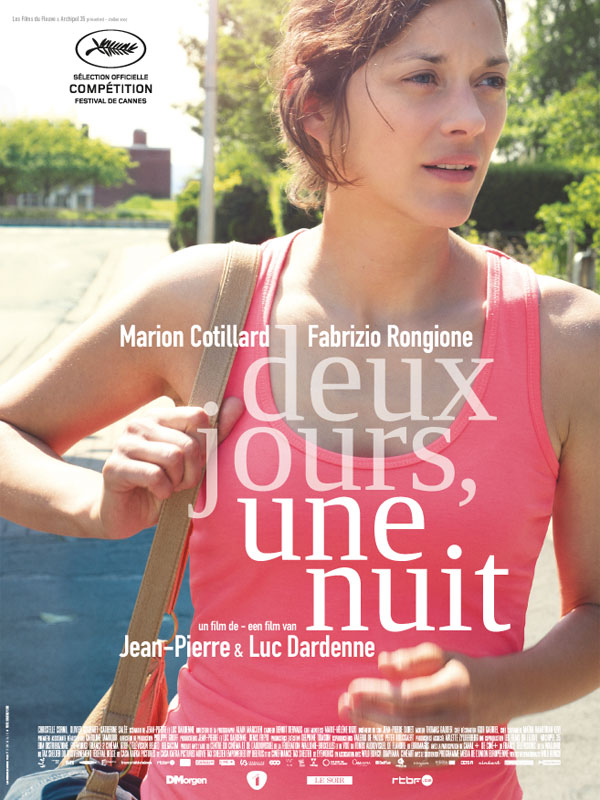
Viennale 2014 – Day 5: Deux jours, une nuit (Two Days, One Night)

Deux Jours Une NuitDeux jours, une nuit (Two Days, One Night)
France 2014
Written by Jean-Pierre Dardenne & Luc Dardenne
Directed by Jean-Pierre Dardenne & Luc Dardenne

After an unspecified accident (however, I got the impression that it got something to do with drowning) and a subsequent struggle with depression, Sandra is finally ready to return to her workplace at a factory, when she receives distressing news: Their boss forced her colleagues to decide to either let her go or to forego their bonuses – and most of them chose their bonus. However, it seems that some of her colleagues were threatened by the foreman, claiming that when Sandra’s not laid off, someone else will. Thus, it was decided to have a new vote on Monday morning, giving Sandra the titular two days and one night to convince a majority of her colleagues to choose her over their bonus.

One of my favorite things about the movie is how Sandra is stuck between a rock and a hard place. There doesn’t really seem to be an ideal solution to this predicament. Because even if she manages to convince enough colleagues to vote for her, she probably won’t be very liked by the other ones who would then also lose their bonuses. Thus, I wasn’t sure if I should actually root for her to win. Ultimately, though, the outcome of the vote (even though the ending was perfect IMHO) doesn’t really matter, because “Deux jours, une nuit” is one of those movies that’s not about the destination, but the journey. The conversations with her co-workers were absolutely great. There’s a different dynamic with each and every one, all of them equally great. I also loved how the movie takes Sandra – and also the viewer – on this emotional rollercoaster-ride, being manic one second, and depressive the next, depending on how the conversation went. Thus, the movie works as a great illustration of bipolar disorder.

On the other hand you have the social angle that shows how many people are struggling nowadays, and which offers a fascinating microcosm of many things wrong in today’s world. You may think that it’s extremely unfair to let the workers decide if they’re willing to forego their bonuses in order for Sandra to be able to stay on, but I totally believed it, and it works as a great example how the “rich” often times set the “poor” against each other so that they’re distracted and don’t see where the root of the problem really lies (I heard this great joke a couple of days back that strikes a similar chord: A banker, an unemployed and an immigrant are sitting at a table, with 13 dollars in front of them. The banker grabs 12 dollars, then turns to the unemployed and says “Watch out, the immigrant will take your dollar away!”).

As good as the individual conversations are, “Deus jours, une nuit” wouldn’t be even half as good without Marion Cotillard (or at least a similarly talented actress) in the role of Sandra. She carries the movie effortlessly, convincingly portraying the different sides of her character, making Sandra likeable despite her flaws and some things that she says and does (her “I feel so alone” to her husband, even though not meant in a mean-spirited way, particularly stayed with me; that’s probably the worst thing a partner/spouse could say to me). Definitely one of the best performances that I’ve seen all year. Pretty much the only thing that I can hold against the movie is that here and there, it felt a little melodramatic, Also, some developments weren’t all that surprising. Other than that, though, it’s très bien, dealing with some timely social issues as well as depression, and offering a great emotional rollercoaster-ride, some hard-hitting scenes, and a superb central performance by one of the best actresses working today.
8/10


IMDB

Posted in cinema 2014, movie reviews, Viennale | Tagged , , , , , , | 2 Comments

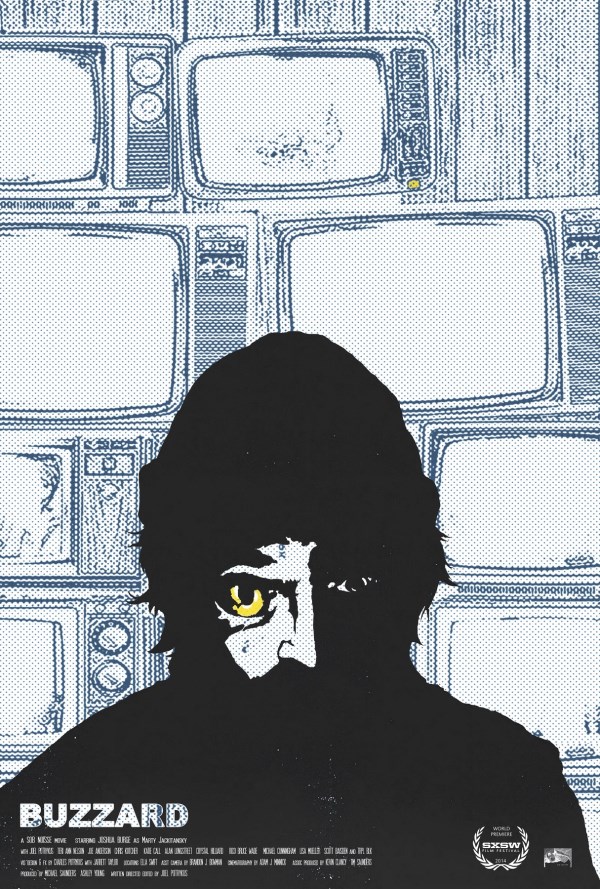
Viennale 2014 – Day 5: Buzzard

BuzzardBuzzard
USA 2014
Written by Joel Potrykus
Directed by Joel Potrykus

“Buzzard” is the last movie of Joel Potrykus’ so-called “animal-trilogy”. I hadn’t seen the other two yet – and probably never will. Nor do I plan on seeing any other movie by him, ever. Because I found “Buzzard” to be downright terrible. It was the second worst movie that I’ve seen all year at the cinema, and the one where I came closest to simply get up and leave (something that I’ve never ever done in my entire life – yet). Which also is an accomplishment in a way, I guess.

It actually starts off ok, with Marty’s little scams to make some money, and the way he tries to find and exploit the flaws in the system; even though I already called bullshit on his first scam (where he closes a savings account and immediately opens a new one at the same bank, in order to get the $100 they’re offering for new savings accounts; usually when you got an offer like that it always states that it’s for new customers only, and doesn’t apply when you had an account with them in the last year or so.), and pretty much already knew where this was going as soon as he sat down to close his account, thus I didn’t find that revelation particularly funny. Still, that and the totally stupid bank clerk a couple of scenes later that even gives him advice on how to cash in checks that he’s written over to himself were quite amusing. Other than that, “Buzzard” was an exercise in annoyance and boredom.

It starts to go off the rails with his check-scam (as funny as I might have found the totally oblivious bank clerk). Before that, he seemed at least somewhat smart. But here… why isn’t he going into different bank stores to cash in the checks, in order to not make it that obvious? Also, as soon as he moves in with his colleague because he thinks that the cops are after him, the movie gets sooooooooo boring. I’m sorry, but I just don’t find it particularly interesting to watch two guys acting goofy and stupid for what feels like half an hour. By far the worst scene, however – and the one that almost had me walk out of the movie – was the infamous spaghetti-take (that even has its own trivia-entry on the IMDB), that simply goes on forever, and is absolutely, completely and utterly pointless. I could feel every precious second from my finite life wasting away during that scene, which went on for at least 5 minutes (even though it feels even longer than that).

After that I was so annoyed with this movie that I couldn’t even appreciate the scene with the bank store manager who calls in the cop, the application of his self-made Freddy Krueger-glove, or the nice and clever last scene with the television sets. I just wished for the movie to be finally over. There’s actually a fade to black after he went to the cinema and for two seconds I hoped that this was finally it and that I was free again at last, but then the movie went on for another couple of minutes. Maybe your mileage will vary, I don’t know. But I found “Buzzard” to be an utterly terrible, boring, annoying and pointless waste of time (there’s your review quote for the poster, Oscilloscope Pictures!)
2/10

Update (Nov. 16th): Joel Potrykus was gracious enough to reply to my review via e-mail (which made me feel a little shitty for pissing on his movie so much; but what can you do? Ultimately, it’s simply my opinion, and I don’t assume it to be the be-all and end-all of it), pointing out two misconceptions. Here’s the direct quote:

I worked as a bank teller for two years. I overheard many other tellers giving the advice of simply depositing a check into the ATM to get the cash immediately. Also, you do not have to be a new customer to qualify for a checking account promotion. We dealt with this several times, and it is something I’ve done three times. It totally works.

Now, to clarify: I had no problem with the bank clerk giving him the advice, and I can’t remember if she did so before or after he started pulling out even more checks. However, one would assume that as soon as someone does that, all alarm bells would go off (as they did later with the clerk at the other bank). I’m totally baffled about the checking account promotion, though; I can’t see something like that ever working in Austria (where you would definitely find some fine print that would prevent you from doing exactly that). However, I stand corrected, so that’s one critisicm that I readily take back.


IMDB

Posted in cinema 2014, movie reviews, Viennale | Tagged , | 1 Comment

Viennale 2014 – Day 4: A Girl Walks Home Alone At Night

A Girl Walks Home Alone At NightA Girl Walks Home Alone At Night
USA 2014
Written by Ana Lily Amirpour
Directed by Ana Lily Amirpour

First of all: What a great and clever title. It immediately invokes certain images, feelings and fears… all of which the movie ultimately proves wrong. Here, the titular girl is not some potential victim, no damsel in distress, but rather the perpetrator, the “monster”. But not only the title was great, but also the movie. If it wouldn’t have been for some rather predictable developments near the end (father, cat, and so on), the fact that the movie started to feel a little long after the +1 hour mark, as well as the rather underwhelming ending itself, I might even rank it among the best movies that I’ve seen at this years Viennale. But even with those flaws I enjoyed it quite a lot.

In the interest of full disclosure, though, I should point out that I saw this with two of my friends from the /slash Filmfestival, and of the three of us, I was the one that – by far – liked it the most. Flo thought that it would have worked a lot better without the vampire angle (which he thought was totally unnecessary), and Lena (whose review you’ll be able to read one of these days on her site) didn’t like it at all, thinking that it drowned in its own coolness. However, for me, the movie worked (apart from the aforementioned flaws, of course). I liked its style, the black and white photography, the heavy western influence, the setting, the sometimes Tarantinoesque feel to it, the concept, and so on. I thought that the “monster” was very well done; the Chador that she was wearing was a clever twist on Dracula’s coat. I also liked the interspersed humor (the movie is surprisingly funny at times), and also the central love story; while nothing special, it was rather nicely developed, with some very romantic scenes.

The actors were quite good too. The standout of the ensemble definitely is Sheila Vand, who has an enigmatic presence that glued my eyes to her whenever she was on the screen. She also has these big, expressive eyes, a beautiful face, and gives a haunting performance. Thanks to her, the titular girl works as well as love interest as she does as a monster. She has a very alluring quality, but can also come off as really threatening. All other actors and actresses pale in comparison, even though Arash Marandi also gives a decent performance. As as someone who just recently started watching HIMYM, it was nice to see Marshall Manesh again. If – apart from the aforementioned flaws – there’s one potential drawback to the movie (which I didn’t mind, but others might), it’s that the story is soooo nothing special. I mean, yeah, it’s nice to see the tables turned and to have the woman as the predator instead of the prey, but even that isn’t particular original anymore, not even in the vampire-movie-subgenre (two other recent examples that come to mind immediately are “Let the Right One In” and “Byzantium”; both of which I found superior to this one, btw). However, the stellar performance by Sheila Vand, the great, moody direction by Ana Lily Amirpour, the glorious black and white photography as well as the tremendous coolness the movie emitted, altogether successfully overshadowed the rather bland story for me.
8/10


IMDB

Posted in cinema 2014, movie reviews, Viennale | Tagged , , , , | 3 Comments

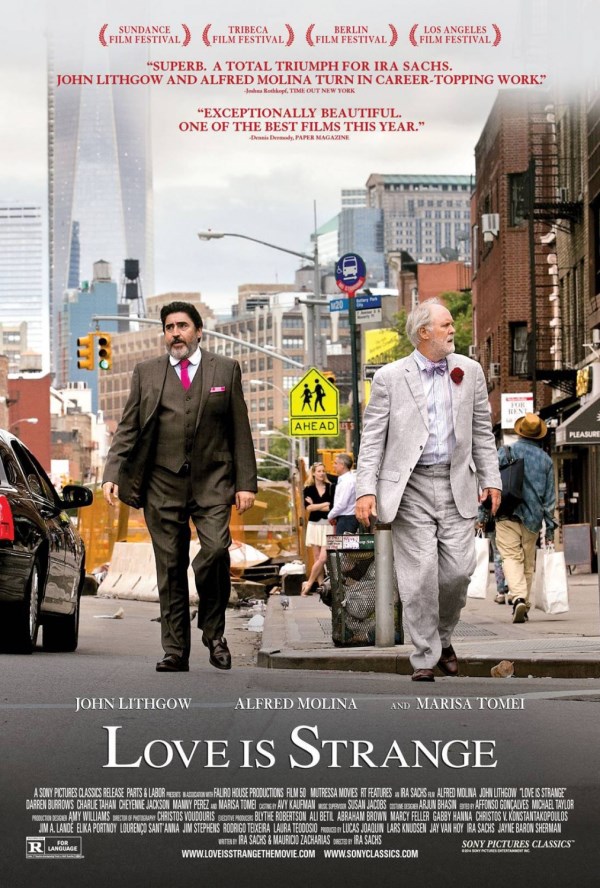
Viennale 2014 – Day 4: Love Is Strange

Love is StrangeLove Is Strange
USA | France | Brazil | Greece 2014
Written by Ira Sachs & Mauricio Zacharias
Directed by Ira Sachs

The major issue that I had with “Love Is Strange” is that I think that the best part of it are the first 15-20 minutes, and that everything that came afterwards didn’t quite live up to that promising beginning. The movie starts with this great depiction of an elderly gay couple, their wedding, and the tragic turn that their life takes directly afterwards, at a time when they both should be at their happiest. But the fact that – because of their marriage – George gets fired from his job gets them into a financial predicament, and as long as they’re looking for a new apartment, they stay with different parts of their family. Ben moves in with his son and his daughter-in-law, while George moves in with another (gay cop) son. Thus, shortly after marrying, they become separated for a longer period for the first time in their life.

Obviously, this puts a serious strain on both of them – and it also did on me as a viewer. I really missed seeing them together as a couple, since that was the heart and the soul of the movie. Whenever they were together, the screen lit up, and the movie got considerably better. Now, I could imagine that this was exactly what Ira Sachs intended; however, it doesn’t make the longer stretches that they spent apart any more bearable and/or entertaining. Because unfortunately, as soon as they were apart the movie lost much of its charm and appeal for me. There are also some rather strange shifts of tone in the movie. Most of “Love Is Strange” is rather matter-of-factly and subdued, but occasionally (especially near the end, which I found to be extremely predictable) it gets really melodramatic. Some of that was just a little bit too much to me, trying too hard to pull at my heartstrings, thus achieving exactly the opposite. Oh, and what was up with the grandson and his friend? I don’t think that I got this subplot.

The main reason the movie kinda worked despite those drawbacks is the cast. John Lithgow and Alfred Molina are absolutely fantastic – and totally believable and convincing – as an elderly gay couple that’s been in love with each other for most of their lives. The supporting cast is also excellent, with the ever-reliable Marisa Tomei a particular standout. Also: I really loved the setup (even though the rest of the movie didn’t quite live up to it), and even during the rest of the movie there were a couple of great, memorable scenes; some funny, some sad. I especially enjoyed a particular joke that the movie worked towards for 2-3 minutes, which paid off in a great way and got huge laughs from the audience. Still, as much as I can understand what Ira Sachs was trying to do here, in my opinion the movie suffers greatly from the fact that Ben and George spent most of the movie separated – a drawback that even the cast and the individual great scenes can’t fully compensate.
5/10


IMDB

Posted in cinema 2014, movie reviews, Viennale | Tagged , , , , , | Leave a comment