Prelude to /slash #02: Scream 2

Scream 2Scream 2
USA 1997
Written by Kevin Williamson
Directed by Wes Craven
Watched on 07.09.2015

“Scream 2” is a good and worthy sequel that nevertheless doesn’t quite reach the same heights as the first one. One of its main problems is that the second time round, the meta-approach isn’t that original and exciting anymore. Yes, this time, they’re discussion the typical sequel rules (and are totally ignoring “The Empire Strikes Back” in their “sequels better than the original”-discussion – dafuq?), but overall, those scenes had a “been there, done that”-feel to them. I also felt that the movie dragged a little bit during the middle. As great as the guessing game concerning the identity of the killer is, but they went a little overboard with the characters themselves sharing their theories. Also, there are a couple of times where Ghostface is extremely lucky (like in one scene where the person he’s talking with on the phone ends up standing directly in front of the place where he’s hiding). The reveal of the killer also, again, wasn’t the most convincing part of the movie (and is also hurt by the fact that they simply copy a certain twist of the first one). And as clever as the protagonists usually act in the “Scream”-movies (at least compared to the low standards of horror/slasher-movies in general), there were a couple of instances (like them not picking up the gun from on the windshield) that had me scream not in terror, but in frustration.

One of the things that I loved about it, and a strength that it shares with its predecessor, is the great beginning – this time at the premiere of the movie “Stab”, which is based on the Woodboro-killings. The whole sequence is absolutely great, with many moviegoers dressed up as Ghostface, a critical contemplation of ethnicity in horror/slasher-movies as well as society’s fascination – and exploitation – of real-world tragedies, funny ideas like the “stab-o-vision”, the restaging of shots from the first one (even though a more critical mind might ask how on earth they could know all that, especially when it comes to the beginning of “Stab” with Heather Graham as Drew Barrymore), the great scene in the toilet, as well as the gruesome death in the theatre itself. I couldn’t have thought of a better way to start this movie. This is not its only great moment, though. I also liked the later scenes during rehearsal in the college theatre, the clever scene with the soundproof cabin, and especially the moment where Sydney and her friend have to climb over a seemingly unconscious Ghostface to get out of the car. That scene is just incredibly tense, and (Sydneys previously mentioned refusal to grab the gun notwithstanding) my personal highlight of the movie (which unfortunately also means that nothing that came afterwards reached quite the same level of suspense again).

“Scream 2” further benefits from a strength that I shamefully forgot to mention in my review of its predecessor: Instead of a seemingly supernatural, invulnerable and unstoppable killer, Ghostface is a man of flesh and blood. He stumbles, he can be hit, and hurt, etc. For some, the unstoppable foe might be scarier, but I feel that a killer that might actually exist in real life (and might stand right behind you RIGHT NOW), is more threatening. Also, in comparison to many other slasher-killers he’s not above running to catch his prey. Another strength of this series is casting. Again, like in the first one, they found a great balance of already well-known and established faces (Sarah Michelle Gellar!) as well as fresh talents that had quite a successful career later on. They also get extra points for actually casting Tori Spelling as Sydney in “Stab”, just as she feared. Think of her what you will as an actress, but she’s definitely a good sport for doing this after being the butt of that joke in “Scream”. Plus, sometimes there’s also a little meta-humor to be found simply in the fact that certain lines are spoken by certain actors (like Gale Weathers claiming that her alleged nude pictures were her face put on Jennifer Aniston’s body – who, of course, was Courteney Cox’ costar on “Friends”). Speaking of which: I very much liked the humor in this (again), since it made the movie quite funny at times, but never at the expense of its suspense.

One aspect where I actually prefer “Scream 2” to its predecessor, is the score. There were a couple of haunting passages featuring a female voice, and overall, I found the music much more eerie. And I really liked the catchy new theme for the Dewey/Gale-romance. The acting is also really good again, and definitely above average than what you’re used to in that genre. Like “Scream”, I once again was especially impressed with Neve Campbell. David Arquette also got a little bit more to do here, and I also enjoyed Courteney Cox, who got to play a slightly refined Gale. It’s not just the recurring cast members, however, the new blood also gives some very good performances. And even though he was only there for one scene, but… kudos for getting David Warner in there! They also do a very good job again to make you guess who the killer might be, and play an especially nice “is he, or isn’t he?” game with Sydneys new boyfriend, played by Jerry O’Connell. Finally, as much as I didn’t like that they used the “killer comes back one last time”-trope yet again, I loved the scene where Sydney, immediately afterwards, put a bullet in his/her brain, just to be safe. It’s what I always wanted to see the characters do in situations like that: Just go ahead and make sure that the fucker’s dead. It’s something that even many recent movies still neglect to do (hello, “The Guest”!), so that was definitely a plus for me. Overall, “Scream 2” is an enjoyable, worthy sequel – but it’s just not as fresh and inventive as the original.
7/10


IMDB

Posted in movie reviews | Tagged , , , , , , , , , , | Leave a comment

Prelude to /slash #01: Scream


ScreamScream

USA 1996
Written by Kevin Williamson
Directed by Wes Craven
Watched on 06.09.2015

Like last year, I want to pave the way for this years /slash Filmfestival – starting this Thursday – with a little prelude. However, the sudden and unexpected death of Wes Craven totally thwarted my original plans for which movies to include here. Thus, I decided to couple my /slash-prelude with a little tribute to one of the true Masters of Horror. I ultimately decided to go with the “Scream”-series (instead of the arguably more iconic and/or popular “Nightmare”-films), mainly because he actually directed all of them himself. But enough preamble, here are my thoughts on the first one:

For whatever reason, I so far probably didn’t appreciate “Scream” as much as I arguably should have. This is most likely due to the fact that when I watched “Scream” for the first time, back then in the nineties, I a) wasn’t really into horror and b) had very little prior experience with the genre. And while I still enjoyed learning about the typical rules of slasher movies, there’s obviously a huge difference between learning about them in this movie, or already knowing them going in. Since then, I’ve seen a lot more horror movies, and also some of the slashers (even though there are still quite a couple that I have to catch up on, like the “Friday the 13th”-series) this movie alludes to, thus I’m much more educated about the typical rules – and those movies itself – than I was back then. However, while that might actually be a good excuse for merely liking the movie when it came out, it’s a little bit more tricky when I face the fact that as short as four years ago, when I watched the trilogy to prepare for the fourth one, I still “only” liked it. One of the things that rubbed me the wrong way on both viewings was my perception that Craven propagated a “horror movies are responsible for real world violence”-message – which also felt rather snarky, especially coming from Wes “Nightmare on Elm Street” Craven. Maybe said impression was due to the fact that on both occasions, I saw the german dubbed version. Maybe it’s because said opinion was widespread back then, and thus stronger at the back of my mind. Maybe my mind shut down as soon as Ghostface (FYI, even though “Scream” is now 19 years old, I’m keeping this post spoiler-free) proclaimed this as his motivation, even though he then ventured into his real, far more grounded, believable and reasonable reasons – thus I kinda overheard it. Or maybe I was just plain stupid. But whatever the reason, I now believe that I was wrong back then with said accusation – which is one of the main reasons why I think much more highly of “Scream” now than I did back then.

That said, even when I saw it in the 90s for the first time, there were many things about it that I appreciated – not the least of which being the beginning. Now I don’t know about you, but given the fact that Drew Barrymore was probably the most well-known name from the cast (back then), I rather would have expected her to be the final girl/main protagonist, then to bite the dust 13 minutes in. But even apart from the fact that on my first viewing, her early demise really surprised me, that whole sequence is absolutely great. The mysterious caller, his questions about horror movies, that great moment when he asks her for her name and when she asks why he wants to know he replies “So that I know who I’m looking at”, the incredibly tension that builds until the “final” kill, the gruesomeness of the death scenes… Now, granted, when it comes to Wes Craven’s filmography, I still have quite some catching up to do. So far, however, I’d proclaim that these 13 minutes are the best thing that he’s ever done. Not that the rest wouldn’t be very good, too. One thing that really stood out for me back then – even though I’m not enough of a horror buff to assert that this was totally new in the genre – was the combination of a typical teenie-slasher-flick with a whodunit-thriller-setup. See, here’s the thing: slasher flicks – especially those where we’re supposed to cheer for the killer – are not my favorite horror-subgenre. The brutal killing of one teenager after another… it can work, if it’s done right, but overall, I’m not the biggest slasher-fan. Thus, I really liked the fact that “Scream” had more going on than that, and that it had you questioning throughout the entire movie who the killer might be. Even the characters are discussion different suspects and swap theories. When the identity of the killer is finally revealed, it comes with a nice twist that, despite the movie’s age, I won’t give away here, but which is really clever.

One of the main things that “Scream” is famous for, and rightly so, is its meta-approach. Again, not the biggest horror-buff speaking, but overall, it’s my impression that before “Scream”, the protagonists of such movies usually gave the impression to have never seen a horror movie themselves. Not so here, and at least I felt that this really was an innovation for the genre. Especially since they actually go ahead and dissect them and explain the typical rules that come with slashers, which over the course of the movie, are alternately followed or broken. I really loved that. It also leads to a couple of very funny scenes, and they even occasionally make fun of themselves (like mentioning an obligatory boob shot, and immediately afterwards denying the audience exactly that). Despite scenes like that as well as a couple of straight-out gags, “Scream” first and foremost is a horror flick, and never ventures too far into parody-territory. There are also some cleverly staged shots, like – to just mention one example – the video feed with a 30-second-delay. Also, most of the performances are really strong, especially Neve Campbell and Drew Barrymore. That said, and despite the fact that I appreciated “Scream” more this time around that I did previously, there still are a couple of things that didn’t really convince me. Despite the fact that it is later revealed that Sydney has an understandable reason for her sexual austerity, it feels a little implausible that they would be together for two years, and never got beyond second base. I mean, despite everything that happened, we’re still talking about teenagers with hormones gone wild. That just felt fake to me. I also would have preferred if there wouldn’t have been that close a connection between what happened to Sydneys mum and what’s happening now. Despite the explanation offered at the end (where I found one to be much more convincing than the other), they failed to explain why Ghostface would kill the people that he kills. It seems after what happened a year ago, he simply enjoys it too much to stop now. Finally, I really could have done without the cliché of the killer who rises up one last time. Given the fact that they made such a big deal out of the fact that this isn’t a movie, but the real world, I would have preferred if they’d consciously renounced that twist. Despite those flaws, “Scream” is one of the most essential and influential horror movies of the 90s – and deservedly so.
9/10


IMDB

Posted in movie reviews | Tagged , , , , , , , , , , | Leave a comment

At the Movies 2015: Fantastic Four

Fantastic FourFantastic Four
USA 2015
Written by Jeremy Slater, Simon Kinberg & Josh Trank
Directed by Josh Trank
Watched on 21.08.2015

Sometimes, movie fans like myself can be just as stupid, ill-behaved and unteachable as little kids. You can tell us hundred times to steer clear of certain movies, but do we ever listen? Like the small kid that can barely reach up to the hotplate and that got warned repeatedly that it shouldn’t touch it, because otherwise it will get burned, we – naturally – touch it, and more often than not, get burned. Which is my experience with “Fantastic Four” in a nutshell. Granted, I usually don’t let myself be influenced by critics too much. If I want to see a movie, I’ll watch it, critics be damned. However, this was actually one of those cases where the abysmal reviews had the opposite effect: Before they came out, I had very little interest of watching this in the cinema. But those terrible reviews actually piqued my interest, and I knew that I just had to see it. Not because I expected them to be wrong, but because sometimes, it’s not enough to just hear about a filmic disaster – you have to see for yourself. Unfortunately, unlike “Terminator: Genisys” that I ended up liking quite a bit, in this case, the critics got it absolutely right, I’m afraid.

This is one of those movies where I don’t even know where to start. Of course, I’ve heard about the problems surrounding this production, and the last-minute re-shoots to fix it (even though I think that those might have done more harm than good – but we’ll come to that later), but to be honest, I got the feeling that this was set to fail from the start, because of some script and/or conceptual issues. First of all: How the fuck could they let Sue Storm stay back? As great as it is that they brought in a little diversity with Johnny Storm, when it comes to gender equality, they totally dropped the ball. I mean, yes, at least she’s not standing at the stove cooking a meal for when the men get home, but come on. If they at least would have mentioned a good reason why she’s not coming with them, but they didn’t even ask her, let alone consider asking her. Instead, when the topic of a fourth team member comes up (why, anyway?), Reed rather calls his old buddy Ben Grimm, who actually had nothing to do with the project, and it seems that Johnny and Victor are perfectly fine with that. Talking about Victor: “Fantastic Four” unfortunately repeats one of the biggest mistakes of the 2005′ one, in having him transformed in the exact same accident that also makes the “Four” fantastic. And as if that wouldn’t have already been enough, they also felt that they needed to add a drama of jealousy to the proceedings. Definitely one of this movies’ worst ideas. Furthermore, it suffers from “Prometheus-Syndrome”, meaning that these scientists act totally irresponsibly and stupid. I mean, sure, when I find an unknown green substance on an interdimensional planet, of course I’d stick my hand into it! What could possibly go wrong?!

What’s even more damning though is that the pacing and/or the structure of the movie is completely off. For example, “Fantastic Four” takes far too long to finally get going. They spend a vast amount of time for setup – but neglect the payoff. I didn’t time it exactly, but it was my impression that by the time they finally got into that apparatus to go where that little toy car has gone before (and seriously, am I the only one who expected them to stumble upon it after their arrival in the other dimension?), half of the movie was already over. The problem with that should be obvious: Like with all superhero origin stories, the point where they finally get their powers usually is when things get interesting. “Fantastic Four” not only takes far too long to reach that point, but they also don’t do anything with it. Say about the Tim Story-“Fantastic Four”-movies what you want, and I’d agree that the first one was mediocre and the second one rather bad, but they really made something out of the characters getting their superpowers, and how they react to, and deal with, that. Especially with The Thing and his transformation, the previous movies did a splendid job. Here, however, they get their powers, get tested a little bit in the lab – and then, exactly when things would get interesting, instead of showing us how they learn to control – and live with – their powers, we jump ahead to “one year later”. Dudes, seriously? What came before already was rather weak, and I had a hard enough time with Sue staying behind – but that’s where the movie finally, and utterly, lost me. We didn’t see the hard work they put into learning to control their powers, didn’t see their struggle to accept their transformation. Thus, when they finally reunite again in the end to save the world, working together as a team – which should be the payoff for all the hardships that they endured before – there’s no meaning to it whatsoever.

That whole last stretch of the movie (I can’t really call it a third act; I’ll get to that in a minute) is a complete and utter mess, and extremely disappointing. Seriously, Kate Mara’s ridiculously obvious wig is the least of its problems – and that’s saying something. It starts with the idea of having the Thing work for the US military in warzones – an idea that might be interesting if it wouldn’t be a little too reminiscent of Dr. Manhattan in “Watchmen”. I constantly waited for the “Ride of the Valkyries” to start playing. Then they finally catch Reed Richards (using Sue’s “pattern recognition”-abilities, from which you just KNEW as soon they were mentioned that they’d come in handy later on), and shortly afterwards, Doom shows up. Not because it feels logical, not because they kinda built to that, but because he had to, obviously. Why is he standing there (did he wait there all the frickin’ time until someone finally appeared?), what does he want, and what’s his motivation? No idea. He’s just there, without any real buildup, because our heroes need a villain, a reason to work together and a chance to save the world. It’s one of the sloppiest bad guy-arcs that I’ve ever seen committed to screen. Then, finally, the showdown comes around, and it’s extremely disappointing. They fight a little bit, then the Fantastic Four have this epiphany that they can’t beat him alone, but that they can do so together, and before you know it, it’s over. And with that, so is the movie, pretty much. After this far too long introduction, to have this extremely short payoff – well, it’s simply a farce.

It also makes “Fantastic Four” feel incomplete, like a movie without a third act. That short brawl with Doom is what you expect during act two, where the heroes get their asses kicked (to emphasize the danger that the bad guy represents). Which again brings me back to the fact that structurally, this movie is a complete and utter mess. It’s like 1-1/2 hour of foreplay without ever getting down to business. It’s all teasing and introducing and preparing, but without any payoff. It’s not just the structure of the overall movie, though. The editing during the whole thing feels off somehow, like there are bits and pieces missing. I guess 20th Century Fox tried their best to save this mess, but as I said at the beginning, it’s possible that they did more harm than good, because the end result is neither fish nor fowl. There’s no flow to it, and the independent acts of the movie hardly go together at all. Instead of tinkering with the movie in the editing room, they would have been better advised to spend some more money on the Special Effects. Granted, the stretching effects of Reed Richards look extremely well, and there’s not much that you can do wrong with an invisible lady. The Thing, however, is a different matter entirely. His animation feels unfinished, and reminded me of some of the shots in “X-Men – Origins: Wolverine” – another Fox movie where they arguably decided to not spend too much money on it anymore, because they already knew that they had a turd on their hands. It’s not embarrassingly bad – but compared to other current CGI-creatures, it falls short, and can never really hide its artificial origins. That said, it still looks a lot better than the Human Torch. Seriously, what was that? It’s just a flaming mass of fire with a couple of black holes in it to represent the eyes and the mouth. Terrible!

A review of this movie (as long as it already is) would not be complete without mentioning this one weird military dude (sorry, I forgot his name) whose only character trait seems to be that he chews gum all the time. Loudly. It was so annoying that I would have loved nothing more than to reach into the screen and smack him. It also was extremely distracting, and took me out of the movie repeatedly. Whoever made this decision should not be allowed to work in the movie business any more. Then again, that’s something that should be considered for pretty much everyone involved in this mess. Everyone, that is, but the actors. The titular foursome – Teller, Mara, Jordan and Bell – all ranged from decent to pretty good. They tried – but if you only got crap to work with, you’re screwed. I’m a little more torn on Kebbell. Yes, Julian MacMahon was incredibly disappointing as Victor von Doom, mostly because we knew from previous roles how captivating, mesmerizing and menacing he can be – but on “Fantastic Four”, he seemed to phone it in. Still, even this muted version of him oozed more charm and charisma than Kebbell does during the entire picture. That said, I can’t rule out this possibility that I simply couldn’t look behind the annoying way his role was written. And even though I liked the performances of the others individually, the last huge problem of the movie is that none of them had any chemistry whatsoever. Neither did I feel the long-lasting friendship between Reed and Ben, nor any sort of sparks between Reed and Sue, and the four of them never really gelled as a team. The only fantastic thing about the movie were the end credits, because then, it was finally over. Other than that, it was an almost complete disaster. “Craptastic Four” would have been a far more apt title for this shitfest. Please don’t repeat my mistake, and steer clear – or you will get burned.
1/10


IMDB

Posted in cinema 2015, movie reviews, new releases | Tagged , , , , , , , | Leave a comment

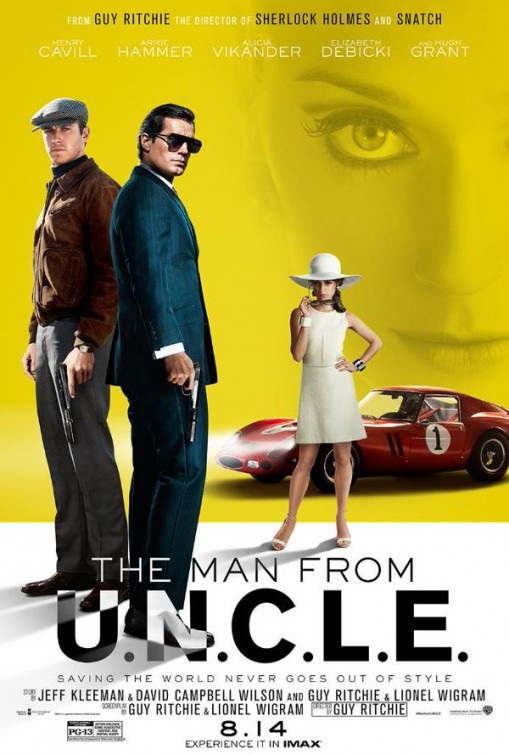
At the Movies 2015: The Man from U.N.C.L.E.


The Man from UNCLEThe Man from U.N.C.L.E.

USA 2015
Written by Guy Ritchie & Lionel Wigram
Directed by Guy Ritchie
Watched on 20.08.2015

While I don’t rule out the possibility that I might have stumbled upon a couple of episode of the 60s TV show as a child, I don’t really remember any of it. Thus, I don’t really have any notable prior history with it – which, with remakes like that, can be a blessing as well as a curse. Blessing because I didn’t have any reference to compare it with, and thus wouldn’t have noticed any major changes to the source material. Curse because “The Man from U.N.C.L.E.” couldn’t profit from some kind of nostalgic feelings that I feel towards the original TV series. Ultimately, it proved to be quite charming and entertaining – but in a year that’s already full of great action flicks and also already offered a couple of spy movies, it unfortunately only rates a poor second.

What I liked most about the movie – and what also set it apart from this years competition of similar films – is that they didn’t bring Solo and Illya into the present, but stayed in the 60s, and made it a period piece. I didn’t live through the swinging sixties myself (and I have to admit that at times it was a little difficult for me to get Austin Powers out of my head), but there definitely is a certain charm and flair to this era that this movie benefits from considerably. It also didn’t hurt that I visited Berlin for the first time in my life a couple of weeks back, and that afterwards, they head to Rome, a city that totally mesmerized me when I travelled it a couple of years back (and would visit again in a heartbeat). It’s always great to see cities and/or places in films that you’ve been to yourself – something that U.S. moviegoers probably experience on a daily basis, but for us here in Europe, it’s a little less common. I also quite liked Guy Ritchie’s direction. The action could have been a little clearer here and there, but overall, he shot the movie with a lot of style, and also again features some of his trademarks (like the speeding up/slowing down of certain scenes). Apart from the 60s setting, though, the movies biggest strength is its cast. Cavill and Hammer have some great chemistry together, and they each play their respective roles very well. Alicia Vikander continues her 2015 winning streak, even though I wasn’t quite as impressed with her here as I was in “Ex Machina” (but that’s most likely due to the fact that her role there was just far more interesting). Jared Harris, Elizabeth Debicki and Sylvester Groth also were very good in their bad guy-roles, and I’m always happy to see Hugh Grant.

On the downside, I found Solo and Illya a little stereotypical. Also, the typical buddy-movie-routine of starting out as enemies/rivals and ending up as friends starts to get a little old, and “The Man from U.N.C.L.E.” does little to have some fun with or enhance the formula in any way. I also felt that it took a little while to really get going. Its biggest weakness, though, is the showdown. While I didn’t mind the rather unspectacular way they got rid of the bad guys at the end (which actually was one of the more clever ideas of the movie), I really wish the showdown on the island that preceded it would have been a little more spectacular, impressive and/or gripping. It also could have lasted a little longer. And the fact that they intercut the planning of the assault with the assault itself kinda prevented me from really immersing myself in the action. Despite these flaws, however, “The Man from U.N.C.L.E.” is a decent action/spy-flick which definitely didn’t deserve to bomb at the box office as hard as it did. Its biggest problem probably was the overabundance of similar movies this year, and its biggest offence is that it offers nothing special – which, however, nowhere near makes it bad.
6/10


IMDB

Posted in cinema 2015, movie reviews, new releases | Tagged , , , , , , , , , | Leave a comment

Austrian Cinema #03: Der Knochenmann (The Bone Man)

Der KnochenmannDer Knochenmann
AUT 2009
Written by Wolf Haas, Josef Hader & Wolfgang Murnberger
Directed by Wolfgang Murnberger
Watched on 08.08.2015

“Der Knochenmann” ranks somewhere in the middle between “Komm, süßer Tod” and “Silentium” for me. Once again, Simon Brenner stumbles into the main crime story pretty much by chance/mistake/bad luck. Initially, he just travels to “Löschenkohl Inn” to collect a car for which the last leasing instalments weren’t paid. However, upon arrival, everyone is strangely evasive when he asks for the whereabouts of lessee Alexander Horvath. Ultimately, though, it proves that his disappearance is not the only – or main – suspicious thing that’s going on there, and before he knows it, he’s thrown into a complex tale of embezzlement, prostitution, and murder.

By now, many of the strengths of “Der Knochenmann” should be well-known from its predecessors. Josef Hader still is the only one that I can imagine playing Simon Brenner, perfectly capturing his dry sense of humor, his attitude and his overall worn-outness. This time, they not only give him the first love interest that worked for me – played in a very charming, down-to-earth and laid-back way by Birgit Minichmayr – but also his best antagonist (so far, back then) in Josef Bierbichler. The two of them get many great scenes that kinda reminded me of the best episodes of “Columbo” (like “Any Old Port In A Storm”), where despite the murderers actions, you could feel a sense of underlying respect and understanding between the two. Also, Bierbichler aka Löschenkohl is the first antagonist that radiated menace, and who really felt like a genuine threat for Brenner. Thus, this, in my book, is the first of the Brenner-movies that apart from being a funny crime story, also had some thriller elements, and offered a couple of truly tense scenes – and also a couple of gruesome moments. However, as is typical for this series, they’re contrasted with a considerable amount of humor, most of it – in typical Austrian fashion – quite dark. The goulash-scene is a particular standout in that regard, but there are many funny moments again that had me laughing my ass off, like the gangster in his wheelchair who can’t get up the icy street. Actually, the amateurishness is probably the one thing that ties all of them – investigator, murderer, gangster etc. – together, and is another element which sets this apart from more traditional crime fare.

There’s also a down-to-earthness and authenticity to these movies that I really adore. To just give you one example: “Der Knochenmann” features one particular sex-scene which is so totally different from what you usually see in movies. It’s not particular erotic and/or arousing, but rather captures the sometimes-not-quite-so-picturebook-ness of sex in appealingly candid fashion. Kudos also has to go out for the revelation concerning the disappearance of Alexander Horvath, which I don’t want to give away here, but which deals with a then still rather taboo issue (which, for reasons I can’t really get into without giving the twist away, people fortunately seemed to ease up on a little bit in the last couple of years) in a pleasingly sober and matter-of-factly way. On a technical level, this is another step up from the already high standard of the previous movie in the series. “Der Knochenmann” offers up a couple of nice, unique shots, and Murnberger really knows (or learned) how to amp up the tension. Thus, his direction further enhances the already very good story. The main reason why, despite all these strengths, “Der Knochemann” doesn’t quite reach the same heights for me as its ultimate predecessor, lies with the finale. As tense as the scenes in the cellar are, overall, the whole Carneval sequence went on a tad too long, losing some of its tension in the process. Furthermore, I slightly prefer the story and the themes of “Silentium” to those presented here, the ending there was a little bit stronger in my opinion, and the mood of the whole picture felt even more bleak, dark and depressing to me (which, yes, is a plus – at least in my book, and concerning the Brenner-movies). Nevertheless, “Der Knochenmann” is yet another great entry to this series, offering up a satisfying mix of crime, thriller, romance and (dark) comedy.
8/10

Finally, I’d like to point out that I already reviewed the fourth – and so far, last – Brenner movie as part of my “At the Movies 2015”-series. If you’re interested, you can find it here -> Das ewige Leben.


IMDB

Posted in austrian cinema, movie reviews | Tagged , , , , , , , , , , , , , , , , | Leave a comment

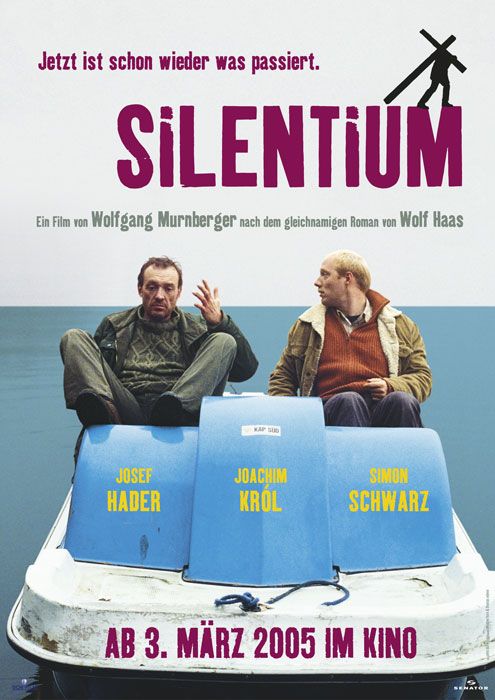
Austrian Cinema #02: Silentium

SilentiumSilentium
AUT 2004
Written by Wolf Haas, Josef Hader & Wolfgang Murnberger
Directed by Wolfgang Murnberger
Watched on 23.07.2015

After the success of “Komm, süßer Tod”, and given the fact that there were many more Brenner-novels by Wolf Haas who awaited adaptation into a movie, it was only a matter of time until a sequel came along. However, the fact that they took four years to complete it already illustrates that this was far from a rush job. Instead, they took the time to do it right – and they ended up with a movie that far exceeded its predecessor.

Back when Wolf Haas wrote his novel, but also when the movie was released, the transgressions of the Austrian clergy – especially when it comes to child abuse – were a hot topic (thanks to accusations that concerned not “just” a simple, regular priest, but rather a cardinal). What I found interesting about “Silentium”, though, is that while child abuse is very much part of this story, it only serves as jumping-off point to set things in motion. The crime that’s at the center of the story, however, is a different one, and somehow – maybe because of the cold, calculated and organized nature of it – I have to say that in a way, I found it even more shocking. Anyway, the crime behind “Komm, süßer Tod” might have been slightly more original and unusual, but I nevertheless prefer the story of “Silentium”. Despite the sometimes bleak nature of some scenes, a sense of (mostly quite dark) humor permeates the movie, further enhanced by the often hilarious dialogue as well as some flat-out gags (like the “North by Northwest”-hommage – the only time that the Brenner movies, so far, ventured into parody-territory – or the great ending to the car chase in the parking garage). Given the rather grim subject matter, this serves as a nice contrast – which, on the other hand, might not be for everyone.

On a technical level, “Silentium” wipes the floor with its predecessor. Everything is much more stylized and polished, with no boom mic in sight. Where “Komm, süßer Tod” simply told the story by pretty much putting the camera in front of the actors, but without much style or flair, “Silentium” is shot much better and feels more thought-out. There are a couple of very well made sequences that manage what the first one couldn’t: Enhance the story through its images, the editing, the music, and/or the mood. The difference is so great that it’s actually hard to believe that it’s pretty much the same technical team, including the director of photography, the editor, and or course director Wolfgang Murnberger himself. One strength that they took over from the last one is casting, and the acting performances in general. Josef Hader proves again to be the only choice to play this role. This time, they also give him a worthy antagonist to play against (I won’t say his name, though, since that would be telling). Simon Schwarz again proves to be a great comedic sidekick, even though the way they stumble into each other feels slightly forced. “Silentium” again features a couple of well-known faces from austrian and german cinema and television, including a cameo by theatre-enfant-terrible Christoph Schlingensief, but it’s obvious that they weren’t hunting for big names, and rather looked for the right people for each role. I also really like the setting. Salzburg is a beautiful city, and even though I haven’t visited it quite as often in my life (so far) as I would have liked, it was great so see a couple of well-known and also lesser-known spots. Finally, I absolutely love the ending – however, I can’t really discuss it without venturing into spoiler-territory.

“Silentium” is a step up from “Komm, süßer Tod” in each and every way, and until a couple of months ago, it was my favorite of the Brenner movies. “Das ewige Leben” might have dethroned it in that regard, but nevertheless, I still very much enjoy it, and rank it among the best that Austrian cinema has to offer.
9/10


IMDB

Posted in austrian cinema, movie reviews | Tagged , , , , , , , , , , , , , , , | Leave a comment

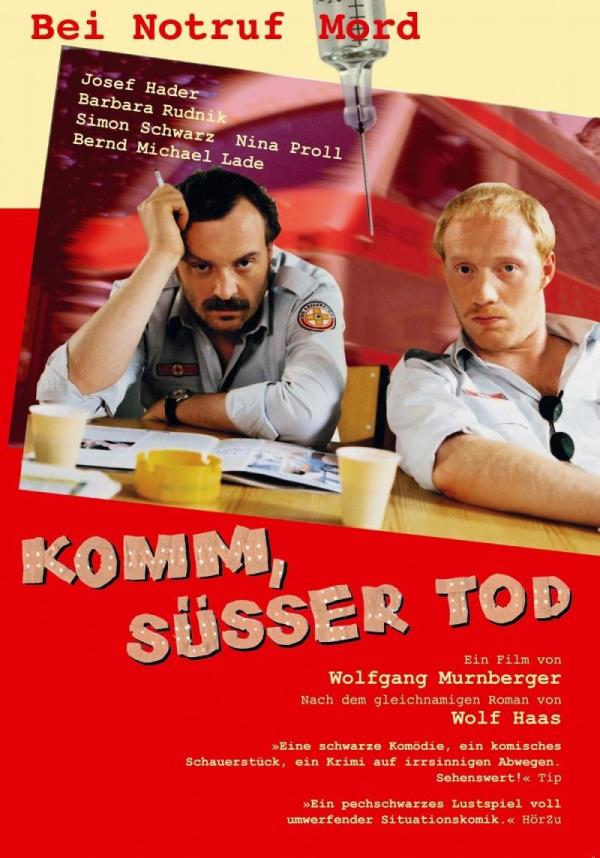
Austrian Cinema #01: Komm, süßer Tod (Come, Sweet Death)

Komm suesser TodKomm, süßer Tod
AUT 2000
Written by Wolf Haas, Josef Hader & Wolfgang Murnberger
Directed by Wolfgang Murnberger
Watched on 13.07.2015

Hello and welcome to yet another new feature on my blog. In this category, I’m going to put the spotlight on Austrian movies (new releases not withstanding, since those will be featured in “At the Movies” or the film festival-columns, respectively), starting with the first “Brenner”-adaptation, “Komm, süßer Tod”, which was shown as part of the Viennese open air-cinema-festival “Kino wie noch nie”.

I had seen this first on TV and then a couple of years later on DVD, but it had been a while, so I was already looking forward to watching it again. And what probably surprised me the most is how raw, unpolished and to some extent flat-out amateurish it is. It was released in 2000, but on a technical level, it looks and feels more like a movie from the late 80s or earls 90s. I can’t remember the last time that I’ve seen so many boom mics (I’d recommend making a drinking game out of it, if I wouldn’t be afraid that you’d go ahead and sue me after getting hospitalized for alcohol poisoning halfway through the movie), and somehow, the movie looks incredibly outdated and old-fashioned. Also, as much as I loved the omniscient narrator in Wolf Haas’ Brenner-novels, and thus am inclined to welcome the voice over commentary, they really went a little overboard with it in the first one, trying to save as much of Haas’ prose as possible – to the detriment of the movie.

However, as much as “Komm, süßer Tod” might have disappointed me on a technical level, overall it’s still a very good movie that established one of the best and most successful Austrian film series of all time. One key factor for this definitely are Wolf Haas’ great crime novels that build the basis for them. Another one is casting. There simply is no better actor, Austrian or international, to play Simon Brenner, than comedian and actor Josef Hader. His dry, dark and melancholical sense of humor fits the role like a glove, and he’s also quite good in the more dramatic scenes. It’s not just him, though, the whole movie is perfectly cast, featuring some well-known faces from Austrian movies and TV (a tradition that the following Brenner-movies would very much follow). I also love the murder mystery. We actually get to know the murderer himself right away, Columbo-style, which already sets this apart from similar movies. The fact that we know who killed the couple in the beginning doesn’t mean, however, that we already know the whole story. Why did he do it? Is someone else behind it? With questions like that, the movie will keep you guessing pretty much until the end, thus it really managed to draw me in and grab my attention. Apart from Hader, though, its biggest strength is its extremely dark and macabre (and thus very Austrian/Viennese) sense of humor. There are a lot of funny scenes, and the dialogues especially had me in stitches repeatedly. Finally, even though I prefer all other Brenner-movies to this, there’s a certain roughness and crudity to “Komm, süßer Tod” that the other ones are lacking, and which give this a unique feel and charm. Thus, despite the fact that it’s rather lacking on a technical level and feeling roughly 10 years older than it actually is, I highly recommend this to anyone interested in dark comedies, crime movies and/or Austrian cinema in general.
7/10


IMDB

Posted in austrian cinema, movie reviews | Tagged , , , , , , , | Leave a comment

At the Movies 2015: She’s Funny That Way

Shes funny that wayShe’s Funny That Way
USA 2014
Written by Louise Stratten & Peter Bogdanovich
Directed by Peter Bogdanovich
Watched on 14.08.2015

“She’s Funny That Way” was the fourth and final Viennale-preview at this years “Kino wie noch nie” open air cinema festival, and it proved to be absolutely perfect for a warm summer’s eve. It doesn’t ask you to strain your brain, it’s not particularly sophisticated and/or thought-provoking, and it doesn’t revolutionize cinema in any way. What it does, however, is entertain. It’s perfect, light summer fare – at least if you’re willing and able to go with it.

One thing that you should be aware of beforehand is that this is a very old-fashioned movie. While it’s obviously set in the present, it very much harks back to the good-old screwball comedies of the 30s and 40s. Which not only shows in the dialogue, but also in the huge amount of coincidences, misunderstandings, and mix-ups that are featured here. The world of “She’s Funny That Way” really is rather small, and everyone seems to know or be somehow connected with anyone. In this regard, the movie completely abandons any form of realism in favor of a good yarn (seemingly following Mark Twains advice “Never let the truth stand in the way of a good story.”). Plus, the fact that the whole story is framed with the interview that the newly-crowned movie star Isabella gives to a cynical reporter, immediately puts the truthfulness of her tale in question anyway (especially given her fondness for embellished stories). Because of that, the questionable plausibility of it all wasn’t really a problem for me. I just sat back and enjoyed the crazy galore of coincidences play out in front of my eyes. In that regard, the script is very clever, and offers up a couple of nice twists and turns. As usual with screwball comedies like that, the scenes where many of the protagonists get together (coincidentally, of course) at the same place were especially funny. My favorite moments of the movie were the audition, as well as the dinner in the restaurant. Those really offered a lot of laughs. The rest of the movie’s very funny, too, but I felt that this was its high point (since one thing that’s so funny about movies like that is for us, the audience, to find out how they’re all connected, and of course later, when the characters find out themselves).

If there’s one scene that fell a little flat for me, it’s the scene near the end, with the rehearsals at the theatre. I don’t know, it just missed something, and I didn’t think it was especially funny and/or clever. Also, in trying to outdo themselves, I felt that Bogdanovish and Stratten wrote themselves into a corner, and the result felt a little forced to me (while all other gatherings before it, despite their implausible nature, always felt organic). The other big problem of the movie is Imogen Poots accent. Now, mind you, I’m not a native speaker myself, thus accents usually aren’t an issue for me, because more often than not, I don’t even notice it if someone sounds wrong for the area he’s supposedly coming from. Here, however, the problem was rather that Poots New Yorker accent sounded incredibly exaggerated and phony to me. And while I usually don’t use IMDB boards as a reference (since you can find a lot of junk and absurdities there), given the fact there are a couple of folks there who also noticed that, I guess I’m not alone (in the matter of full disclosure, however, I should point out that I know Poots from other roles, and thus know her genuine british accent – which might have oversensitized me in that regard). Apart from that, though, I really liked her performance. Her standout-moment definitely was the aforementioned audition, however, she was also very charming during the rest of the movie. I also enjoyed all the other actresses and actors, especially Kathryn Hahn, Owen Wilson and Rhys Ifans. Some might criticize some of them for overacting, but IMHO, with a comedy like that, where they rather play exaggerated caricatures than real people, that’s very much the point.

Overall, I really enjoyed “She’s Funny That Way”. It’s nothing revolutionary, but it’s a very funny, charming and old-fashioned movie that belies the age-old saying “They don’t make them like that any more” – because Peter Bogdanovich did. And a good thing, too!
7/10


IMDB

Posted in cinema 2015, movie reviews, new releases | Tagged , , , , , , , , , | Leave a comment

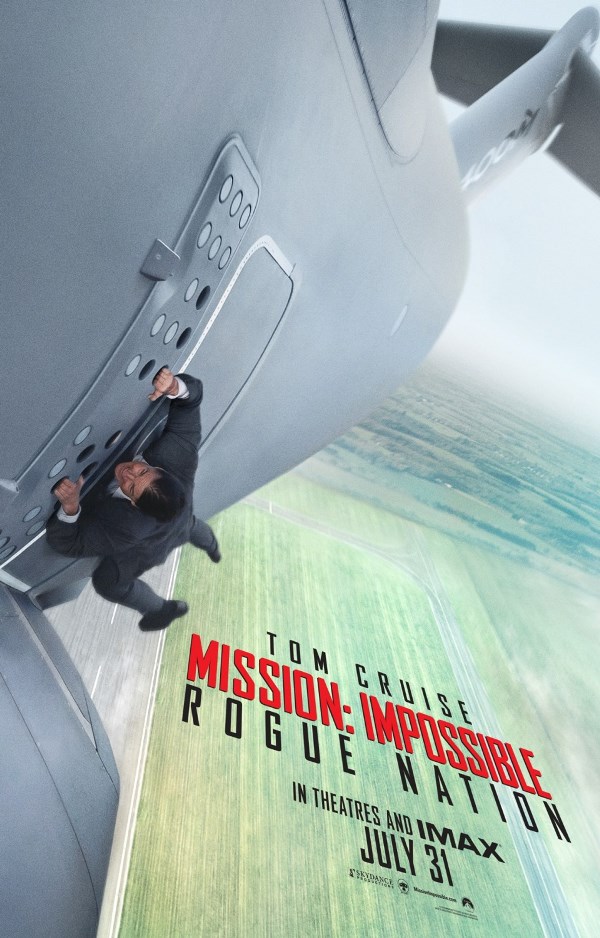
At the Movies 2015: Mission Impossible – Rogue Nation

Mission Impossible Rogue NationMission: Impossible – Rogue Nation
USA 2015
Written by Christopher McQuarrie & Drew Pearce
Directed by Christopher McQuarrie
Watched on 12.08.2015

Let’s do a short recap: I really liked the first one, but thought that the great spy-plot was in conflict with the more over-the-top, ridiculous action bits (say: Channel Tunnel). The second one was incredibly disappointing, and a complete disaster. Part 3 was a return to form, mostly thanks to a better script and the best villain in the series so far. “Ghost Protocol” was another step up for the series, with some incredible, breathtaking action sequences (Burj Khalifa), which only got bogged down by a weak bad guy and an underwhelming finish. Overall, I wouldn’t say that I’m the biggest fan of the series, but with the exception of the first one, I saw all of them in the theatre, and apart from Woo’s entry, never regretted that decision.

I would need to watch the whole series again to be absolutely sure, but “Rogue Nation” might actually – by a narrow margin – be the best one so far. What I found most interesting about it is that, after mostly following the “bigger and greater”-Hollywood-formula for sequels, this one actually felt less action-y than the last ones, and seemed to hark back more to the first one (which was more spy thriller than action movie). I was also really astonished when I noticed that the biggest and most impressive action sequence, that also was front and center in the marketing campaign, actually happens in the first couple of minutes of the movie. More than anything, that definitely had me intrigued, because if they thought that they could start with this stunning sequence without being afraid that what would follow afterwards would feel like a letdown, I couldn’t wait to see what they had in store for us. Thankfully, the rest of the movie didn’t disappoint – and I’m really impressed that Christopher McQuarrie, Tom Cruise, and the whole production team had enough confidence in the cinemagoers to afterwards rely mostly on a thrilling, compelling story with numerous twists and turns, instead of one bloated action scene after another (which is not to say that the action afterwards wasn’t also very well done, and quite gripping, be it the break-in or the motorcycle chase; but it was a lot more grounded than I’ve come to expect from movies like that, and even compared to the previous entries in the series). There’s a confidence and a self-assuredness to it all that I found quite impressive.

Apart from that, as well as that stunning first action sequence, the main standout of the movie definitely is Ilsa Faust. Played to perfection and with incredible charm and charisma by Hollywood-newcomer Rebecca Ferguson (a star-making performance if I’ve ever seen one), she is the heart and soul of the movie, and very much at its centre. Like another of this years blockbusters, “Mad Max: Fury Road”, she’s the driving force behind most of what happens in the movie, with the male lead mostly being there for the ride. I loved absolutely everything about that character, and her performance, but it was especially great that she actually followed her own interest (instead of being there to offer incentive for the male lead, or to simply tag along), and that she could stand her own, and didn’t depend on Ethan Hunt to save her (actually, in a great twist of formula, its actually the other way around here). The villian, Solomon Lane, also was definitely a huge step up from the disappointing baddie in “Ghost Protocol” – even though he still wasn’t quite as impressive as I would have liked, let alone nearly charismatic and menacing as the unforgettable Philip Seymour Hoffman in “Mission Impossible III”. However, I liked that he had a reasonable and understandable agenda (and motivation) of his own, and that he offered a mental challenge for Hunt, rather than a psychical one. And I just loved the outcome of their contest, which mirrored a scene from the beginning. That was mightily clever, and a welcome change from how movies like that usually end.

Another thing that stood out for me – understandably – was the portion of it that played in my own home town in Vienna. While movie fans in America, especially when they live in one of the major cities like LA, NY or SF, should be very familiar with seeing their home turf in a Hollywood blockbuster, it’s a rather rare feeling for me. I especially loved the prolonged sequence at the opera, which not only used that location perfectly, but also was one of the most gripping scenes of the movie in itself. Anyway, given all that, I’m more than happy to overlook the geographical error of having Benji get out at Schottenring station and walk out of Karlsplatz station (He probably beamed himself over there 😉 ). I also really loved the credits sequence, with its short glimpses of the things to come. It’s been far too long since I saw it but wasn’t that something that they also did on the classic tv show? Anyway, I felt that this was a nice touch. Finally, I found Joe Kraemer’s approach to scoring this movie interesting. It almost seemed like the opposite of what they to with the Bond-theme in 007 movies recently, where they usually only play it during specific scenes, and then during the end credits (while at the beginning, you usually only hear the first notes of it). Here, the well-known MI-theme can be heard during the opening credits, and is then pretty much ever-present all through the movie; however, only in a shortened, slightly varied version which never reaches its crescendo. The full theme is only heard again during the end credits. I still don’t know if I liked that or not, but as I said, as a score-buff, I found it interesting to compare this approach to the recent Bonds. Apart from the still-not-overly-impressive villain, one or two rather predictable twists, the fact that it drags marginally from the end of act two to the middle of act three, and said musical approach, though, “Rogue Nation” definitely accomplished its mission.
8/10


IMDB

Posted in cinema 2015, movie reviews, new releases | Tagged , , , , , , , , , , , | 1 Comment

What’s on TV? #02: Sense8 (Season 1)

Sense8Sense8
USA 2015
Created by J. Michael Straczynski, Andy Wachowski & Lana Wachowski
Watched from 05.06.2015 – 08.06.2015

While here on my blog, I concentrate mostly on movies, the lion’s share of articles that I write for the german webpage fictionBOX are actually episodic reviews of TV shows old and new. Unfortunately, I haven’t got the time to translate and transfer them over to my blog; however, I thought that it could be interesting (and manageable, time-wise) to review whole seasons. Thus, after the one-shot review for the SyFy-TV-event “Sharknado 3”, I’ll continue this fairly new segment on my blog with a review of my most anticipated new show of 2015, “Sense8”.

Before we start, a little background information: I’m a huge fan of J. Michael Straczinsky’s SF-epic “Babylon 5”, which, to this day, still is my favorite TV-show of all time (from those that I’ve seen, obviously). I’m a little more torn on the Wachowski’s, which seem more hit and miss to me. I’m actually one of the few who quite liked the “Matrix”-sequels, but on the other hand, I couldn’t really stand “Speed Racer”. I thought “Cloud Atlas” was a masterpiece, while “Jupiter Ascending” was a huge failure. They continue their rollercoaster ride with “Sense8” which I found – pardon the pun – sensational. Now, before I continue: I understand everyone who has no use for it. It’s a very divisive and very unique show. Be it the occasional sex scene (nothing too graphic, though, so if you can deal with the nudity in “Game of Thrones”, you should be fine), the very liberal agenda, the sometimes in-your-face-edginess of it, the partially clichéd personal stories of the sensates, or the very weird mix in content and tone, I get everyone who tries it and says “Nah, not for me.” It also seems like a big deviation from the current trend in TV, which seems to get darker and darker with each and every season. Thus, a show like “Sense8”, which despite some tense, dramatic and even tragic scenes, is mostly about optimism and hope, and which features a certain amount of playfulness, glee, vitality, bouyancy and joie de vivre that is in stark contrast to the current TV-landscape, must necessarily feel like a tonal shift for which not everyone might be on board, and I totally get that.

I also have sympathy for the critics. While I actually loved the first hour, I’m totally aware that I’m in the vast minority on that, and that it has probably more to do with my weird preference for being thrown into a new “world” and getting to know new “people”, than with the quality of the kick-off itself. For some reason, I also didn’t find it overly confusing; I was much too enamored in the individual stories for that. However, since many viewers who later fell in love with the show also claim that they had a hard time getting through its extra-long first episode, you hardly can blame the critics for having a similar opinion. Also, I strongly believe that Netflix did “Sense8” a huge disservice by only providing the first three episodes in advance to critics, since many viewers stated that for them, episode 4 was the one where everything started to come together. It also features one of the best scenes of the whole season with the globe-spanning singalong of 4 Non Blondes’ “What’s Up”. I think if Netflix would have sent them the first four episodes, early word would have been much more positive. As for me: As I just said, I actually loved the first hour. I actually think that it was rather the middle part where the show started to drag along a little bit. By that time, we already had a good enough indication of what each and every personal story was all about, and where it would probably lead, but they took a little too long to start explaining the mythology behind the show, and also seemed to drag their heels in some of the individual stories. However, the final four episodes where absolutely great, and more than made up for that. Thus, “Sense8” is a show that demands, but also rewards, patience.

Is it perfect? Hell no. As I just mentioned, it takes a little too much time to really get into the overall mythology (as well as some of the personal stories; for example, Sun’s dilemma is explained rather late in the game, which made it difficult for me to really feel for her, since I didn’t understand what exactly her struggle was all about), and – possibly even more damning – once it does, I’m not even sure if I buy all of it. Some parts of the explanation seemed a little hokey too me, which is why all in all, I enjoyed the personal arcs more than the overall mythology. There are also some things left unexplained. For example, in some instances where they “visit” each other, or share certain abilities, they act out their movements, and sometimes they don’t. In a later episode, they suddenly kinda freeze time during their conversation, an ability neither shown before or after, nor explained. There’s also no explanation for a sudden loss of connection that happens during the season, and which seems to be only there to heighten the tension and the drama, but for no narrative reason at all. There are also a couple of scenes where it seemed to me like they talked down to the audience, or where they not let the scenes and/or images simply speak for themselves, which is especially weird – and contradictory – in a show that otherwise demands so much from its viewers. Also, not every idea worked for me. For example, Lito’s PMS reminded me a little bit too much of the much-loathed “Junior”. And some of the more brutal scenes seemed to be in conflict with the more empathic tones of the show. My biggest beef with Season 1, however, was the Sarah Patrell-mystery, which seemed to be totally removed from the rest of the show, and which was left completely unexplained. It just didn’t add anything of value to me, and in a show that already has no shortage of open questions, it seemed like one mystery too much.

However, in my book, the good ultimately far outweighs the bad. For one, I loved the international nature of it. I know that recently, TV-shows have become more and more international, but “Sense8” really is another huge step off from the recent development. I especially liked the scenes set in India and Nairobi, since they offered a glimpse into a world that’s definitely underrepresented in (US-)TV-shows (Berlin, too, but living in Vienna, that’s not too far off for me culturally). Also, having seen the show now I totally get why they decided not to do subtitles (as cool as that might have been), since roughly 2/3rds of the show play in non-english-speaking regions. Subtitling all of that just would have been too much. Also, the entire show looks absolutely incredibly. Again, TV definitely has come far in the last 20 years or so, but nevertheless, “Sense8” seemed to be a step above the rest. Their decision to shoot almost entirely on location (hell, even the scene on the plane was actually shot midflight!) definitely pays off, and as you can expect from the Wachowskis, it’s shot incredibly well, with the action scenes particular standouts. They also offer up some beautiful landscapes; especially Iceland looks absolutely stunning. Said scenes were even enhanced by the disparity between the beauty of the landscape and the bleakness and sadness of some of its content. It’s not just the visuals, though, the music is great too, be it the original score by Tom Tykwer and Johnny Klimek, or the songs chosen to accompany certain scenes. I shazamed the shit out of this show! What’s also crucial is that pretty much from the beginning, I liked all of the eight main characters. In my very humble opinion, there’s not one weak link found here. Same is true for the supporting cast, with Amanita being a particular standout. I’m head over heels in love with her, and she gets some of the funniest lines of the season, some of which almost had me roll off my couch with laughter. It’s also obvious how much time and care went into creating these characters. They’re not just there to get entangled into the overall mystery; each of them gets their own individual, unique backstory, their own struggle. Ultimately – and admittedly after a slighty bumpy road – all of this finally culminates in an incredibly tense and intense season finale which offered the finest hour of TV that I’ve seen this year so far (and yes, that includes “Hardhome”).

What really makes this show stand out, though – and where its goals and teachings are the most apparent – is in the scenes where the sensates connect with each other. There, “Sense8” takes the rules and possibilities of the modern world – with cell phones, the internet, Skype and so on, which allow instant connection (almost) all over the world – and heightens them, presenting an instant telepathic connection between those eight individuals, scattered all over the world. I love how their different upbringings, roots, cultures and so on are never an issue. These eight characters share a very specific bond, and in the way they help each other – sometimes with direct action (offering some of the best scenes the first season has to offer), and sometimes with simply being there for each other, listening to and sharing each others problems – “Sense8” makes a strong case for more empathy and compassion in the world. Its creators seem to want to assure us that none of us really is alone. That we are stronger together than we are apart. And how, through understanding and compassion, we can all make the world a better place, for us, and for everyone else.

As of the moment I write this, there’s no word on renewal yet (something that might change from now until this review is ultimately posted). And as much as I hope that this is more a matter of logistics and negotiations than of a general unwillingness on Netflix’ part, if this 12 episodes really should be everything that we’ll ever get of “Sense8”, then I’ll be able to live with that. Because as short as its run might have been in that case – and despite the lukewarm early reception by critics – it definitely has left an impression. There is a huge number of truly devoted fans out there, who have watched the entire run multiple times already, and right now, fans all over the world celebrate #sense8day (since August 8th is the birthday of the cluster). It is a community that, like the show it stems from, is grounded in mutual respect, empathy and understanding, spanning the entire world, and bringing together different voices from the most diverse origins. They come together to celebrate something that they all deeply care about. Their lives might vastly differ from each other, but they’re unified in their love for this show. If this should really be it, if one season is all that we’re getting from “Sense8”, I can’t think of a bigger and better legacy than that.
7.5/10

“Sense8” is currently streaming on Netflix all over the world. If you would like to get in on the discussion, I suggest joining the official Sense8 group on Facebook. If you’re interested in my thoughts on each individual episode, let me point you to the JMSNews Forums, where you’ll find short notes from me in the Spoiler threads of each and every episode (look for cornholio1980). Finally, in case you can read german, please let me refer you to my extensive episodic reviews of “Sense8” on fictionBOX.

Update: As many fans – me included – have hoped, “Sense8” was officially renewed on 08/08/15 by Netflix. Yay! 🙂


IMDB

Posted in new releases, What's on TV? | Tagged , , , , , , , , , , , , , , , , , , | 6 Comments